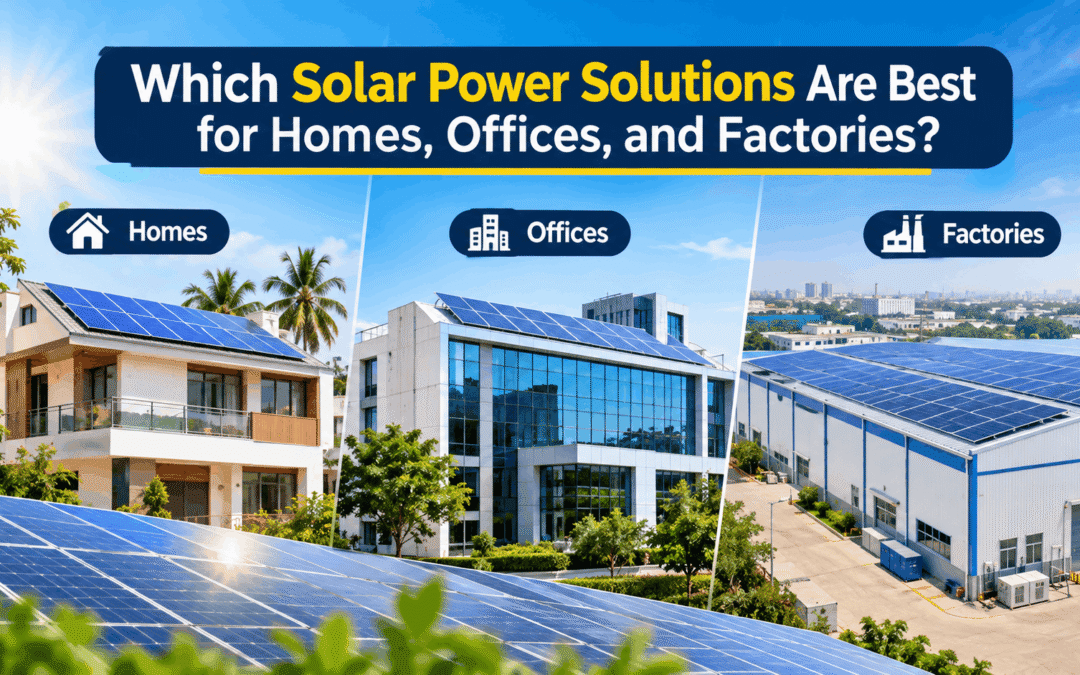
Solar energy is becoming an increasingly practical choice for homes, commercial buildings, and industries across Chennai and Tamil Nadu. With rising electricity expenses, growing energy requirements, and increasing interest in renewable energy, many property owners and business operators are exploring solar power as a long-term solution.
However, one important thing to understand is that the best solar power solution for a home may not be the right solution for an office or a factory.
A homeowner may want to reduce monthly EB bills and receive the benefits of rooftop solar. An office may be looking for predictable electricity expenses and better energy management. A factory, on the other hand, may need a larger solar installation capable of supporting heavy machinery and daytime production requirements.
Each situation requires a different approach.
Tamil Nadu has considerable potential for solar energy, and Chennai’s sunny climate makes rooftop solar worth considering for residential and commercial properties. But choosing the right system involves more than installing panels on an available roof. Electricity consumption, operating hours, roof space, sanctioned load, connection category, and investment capacity all play important roles.
In this guide, let’s explore the best solar power solutions for homes, offices, and factories, with practical considerations for property owners and businesses in Chennai and across Tamil Nadu.
Understanding the Right Solar System for Residential, Commercial and Industrial Needs in Chennai
Solar energy is becoming an increasingly practical choice for homes, commercial buildings, and industries across Chennai and Tamil Nadu. With rising electricity expenses, growing energy requirements, and increasing interest in renewable energy, many property owners and business operators are exploring solar power as a long-term solution.
However, one important thing to understand is that the best solar power solution for a home may not be the right solution for an office or a factory.
A homeowner may want to reduce monthly EB bills and receive the benefits of rooftop solar. An office may be looking for predictable electricity expenses and better energy management. A factory, on the other hand, may need a larger solar installation capable of supporting heavy machinery and daytime production requirements.
Each situation requires a different approach.
Tamil Nadu has considerable potential for solar energy, and Chennai’s sunny climate makes rooftop solar worth considering for residential and commercial properties. But choosing the right system involves more than installing panels on an available roof. Electricity consumption, operating hours, roof space, sanctioned load, connection category, and investment capacity all play important roles.
In this guide, let’s explore the best solar power solutions for homes, offices, and factories, with practical considerations for property owners and businesses in Chennai and across Tamil Nadu.
1. What Are Solar Power Solutions?
Solar power solutions are systems that convert sunlight into usable electricity through solar photovoltaic (PV) panels.
These systems can be installed on residential rooftops, office buildings, commercial properties, factory rooftops, and open land.
A typical solar power system includes:
- Solar panels: Capture sunlight and generate DC electricity.
- Solar inverter: Converts DC electricity into AC electricity used by electrical equipment.
- Mounting structures: Secure the solar panels in the appropriate position.
- Electrical protection: Includes cables, circuit breakers, isolators and earthing arrangements.
- Solar meter: Measures electricity imported from and exported to the grid, where applicable.
- Battery storage: Stores excess solar electricity for later use in systems designed with batteries.
The right combination depends on the property’s electricity requirements and how the electricity will be used.
2. Best Solar Power Solutions for Homes in Chennai
For most independent houses and residential properties, rooftop solar is one of the most practical ways to reduce electricity expenses.
Homes in areas such as Velachery, Tambaram, Anna Nagar, Porur, Medavakkam and OMR can explore rooftop solar depending on roof availability, electricity consumption and local installation feasibility.
Let’s look at the most suitable residential solar options.
A. On-Grid Solar System – Best for Regular Household Electricity Savings
An on-grid solar system connects directly to the electricity grid.
During daylight hours, solar panels generate electricity, and the home’s electrical appliances use the available solar power. When solar generation is insufficient, electricity is drawn from the grid.
If the system generates more electricity than the home consumes, surplus energy can be exported according to the applicable metering and billing arrangement.
Why is it suitable for Chennai homes?
- Helps reduce monthly electricity expenses.
- Does not require batteries.
- Makes use of available rooftop space.
- Requires relatively less maintenance than battery-based systems.
- Can be expanded or designed according to household consumption, subject to applicable requirements.
For example, a family using air conditioners, refrigerators, washing machines, lights and other appliances during the day can benefit from a properly sized rooftop solar system.
One important point: conventional grid-connected solar inverters automatically disconnect during a grid outage for safety. Therefore, an ordinary on-grid system does not provide backup electricity during power cuts.
B. Hybrid Solar System – Best for Homes Requiring Backup Power
A hybrid solar system combines solar panels, a hybrid inverter, battery storage and, where applicable, a grid connection.
Unlike a conventional on-grid system, a properly designed hybrid system can store excess solar electricity in batteries and supply selected household loads during power interruptions.
It can be useful for homes that need electricity for:
- Refrigerators
- Essential lighting
- Fans
- Wi-Fi routers
- Computers
- Selected air-conditioning loads, depending on battery capacity
For Chennai homeowners who experience power interruptions or want additional energy independence, hybrid solar is worth considering.
However, battery capacity, backup duration, inverter rating and battery chemistry should be evaluated before choosing this option.
C. Off-Grid Solar System – Best for Properties Without Reliable Grid Access
An off-grid solar system operates independently of the electricity grid.
It uses solar panels, batteries and an inverter to supply electricity to the property.
This option may be suitable for remote properties, isolated buildings and locations where grid connectivity is unavailable or unreliable.
For most urban homes in Chennai that already have a regular electricity connection, an off-grid system may not be necessary.
Which Residential Solar System Should You Choose?
| Solar Solution | Best For | Main Advantage |
|---|---|---|
| On-grid solar | Regular residential homes | Reduces electricity bills |
| Hybrid solar | Homes needing backup | Solar generation with battery storage |
| Off-grid solar | Remote properties | Independent electricity supply |
Our recommendation: For a typical Chennai home with a reliable electricity connection, an on-grid rooftop solar system is a sensible starting point. Choose a hybrid system if backup power is an important requirement.
3. Best Solar Power Solutions for Offices and Commercial Buildings
Offices have different electricity requirements compared with residential properties.
Commercial buildings often consume significant electricity through:
- Air-conditioning systems
- Computers and servers
- Elevators
- Lighting
- Printers and office equipment
- Ventilation systems
- Water pumps
In Chennai, IT offices, corporate buildings, hospitals, educational institutions, shopping complexes and commercial establishments can explore solar power to manage their electricity expenses.
Here are the most suitable options.
A. Commercial Rooftop On-Grid Solar
Commercial rooftop solar is one of the most practical solutions for offices with sufficient roof space and regular daytime electricity consumption.
During office hours, solar-generated electricity can directly support air-conditioning, lighting, computers and other equipment.
This is particularly useful because many offices operate during the same hours when solar panels generate electricity.
Key benefits:
- Reduces electricity purchased from the grid.
- Makes productive use of unused rooftop space.
- Helps manage long-term operating expenses.
- Supports corporate sustainability goals.
- Can reduce dependence on conventional electricity sources.
For example, an office building in Guindy or OMR with substantial daytime air-conditioning requirements may be able to use a significant portion of its solar generation directly.
The system should be sized according to the building’s actual electricity consumption and applicable connection requirements.
B. Solar with Battery Storage for Critical Office Loads
Some commercial buildings cannot afford interruptions to important electrical equipment.
For these properties, battery-integrated solar systems can support selected loads during grid outages.
They may be useful for:
- Server rooms
- Security systems
- Emergency lighting
- Networking equipment
- Critical communication systems
However, battery backup should be designed around the actual backup requirement. Supporting an entire commercial building requires a substantially different investment from supporting only essential equipment.
C. Solar Carport Systems for Commercial Properties
Commercial buildings with large parking areas can consider solar carports.
In this arrangement, solar panels are installed above parking spaces using specially designed supporting structures.
The system generates electricity while also providing shade for parked vehicles.
Solar carports can be useful for:
- IT parks
- Shopping malls
- Office campuses
- Hospitals
- Educational institutions
- Commercial parking facilities
This is an interesting option for properties that have limited rooftop space but sufficient parking-area potential.
Which Commercial Solar Solution Is Best?
| Solar Solution | Suitable Application | Main Benefit |
|---|---|---|
| Rooftop on-grid | Offices and commercial buildings | Reduces daytime grid consumption |
| Hybrid solar | Critical commercial operations | Backup for selected loads |
| Solar carport | Office campuses and parking areas | Generates power while providing shade |
Our recommendation: For most Chennai offices, commercial rooftop on-grid solar is a practical starting point. Battery storage can be added when business continuity requirements justify the investment.
4. Best Solar Power Solutions for Factories and Industries
Factories generally have much higher electricity requirements than homes and small offices.
Manufacturing facilities use electricity for machinery, motors, compressors, production lines, cooling systems, pumps, lighting and other industrial equipment.
In industrial areas such as Ambattur, Sriperumbudur, Oragadam, Guindy, Maraimalai Nagar and Hosur, electricity expenses can represent a significant part of operating costs.
For these businesses, solar power should be planned as an energy-management investment rather than simply a rooftop installation.
Let’s explore the major industrial solar solutions.
A. Industrial Rooftop Solar – Best for Factories with Available Roof Space
Industrial rooftop solar is one of the most suitable options for factories with large unused rooftops.
Warehouses, manufacturing facilities and industrial buildings often have considerable roof areas that can accommodate solar panels.
The electricity generated can be used within the factory to support daytime production activities.
Major benefits:
- Reduces electricity purchased from the grid.
- Makes productive use of existing factory rooftops.
- Helps manage long-term electricity expenses.
- Supports renewable energy and sustainability objectives.
- Can be designed for different industrial electricity requirements.
For example, a manufacturing unit operating machinery during daylight hours may use solar electricity directly instead of purchasing the same amount of energy from the grid.
However, industrial rooftop installations require proper engineering.
Before installation, the project team should evaluate roof strength, available space, electrical infrastructure, sanctioned demand, transformer capacity and safety requirements.
B. Ground-Mounted Solar Power Plant
Not every factory has enough rooftop space for the required solar capacity.
Some industrial facilities have vacant land near their manufacturing units or access to suitable land elsewhere.
In such situations, a ground-mounted solar power plant can be considered.
These systems use solar panels installed on specially designed structures on open land.
Suitable for:
- Large manufacturing companies
- Industrial campuses
- Businesses with available land
- Companies requiring larger renewable energy capacity
Ground-mounted systems can be designed at a larger scale, but land availability, approvals, evacuation infrastructure, connectivity and project economics must be evaluated.
C. Captive Solar Power Solutions
Captive solar power is an option for businesses that want to generate electricity for their own consumption.
A company can develop a solar project for its own use, subject to the applicable electricity regulations and project structure.
The solar plant may be located at the factory itself or at another suitable location, depending on the arrangement.
This can be useful for industries that:
- Have high electricity consumption.
- Operate during solar generation hours.
- Have suitable land or rooftop space.
- Want greater control over their renewable energy procurement.
For businesses considering off-site captive solar, ownership, consumption requirements, open-access permissions and applicable charges need to be reviewed carefully.
D. Group Captive Solar Power
Group captive solar is another option for eligible industrial and commercial consumers.
Under this model, multiple electricity consumers participate in a solar power project through an ownership arrangement that meets the applicable captive generation requirements.
It can be worth evaluating for businesses that:
- Have high electricity consumption.
- Cannot accommodate a sufficiently large solar plant on their premises.
- Want to participate in a shared renewable energy project.
- Can meet the applicable ownership and consumption conditions.
Group captive projects require careful regulatory and financial planning. They should not be treated as an automatic low-cost electricity arrangement.
E. Open Access Solar Power
Open access solar allows eligible electricity consumers to procure renewable electricity from a generating plant through the electricity network.
This can be useful for factories and larger commercial establishments that require more solar electricity than their own rooftops can generate.
Businesses may explore different procurement arrangements, including captive and group captive structures, depending on eligibility and applicable regulations.
Before choosing open access, companies should evaluate:
- Electricity consumption patterns
- Contract demand and sanctioned load
- Applicable open-access charges
- Transmission and wheeling charges
- Banking and settlement provisions
- Cross-subsidy and additional surcharges, where applicable
- Contractual and regulatory requirements
For a factory in Tamil Nadu, these factors can significantly influence the actual savings.
Our recommendation: Industrial rooftop solar is a good starting point for factories with suitable roofs. Larger consumers should also evaluate ground-mounted captive solar, group captive and open-access arrangements based on their electricity consumption and financial objectives.
5. Comparison: Best Solar Power Solutions for Homes, Offices and Factories
Choosing the right solar system becomes easier when you compare the requirements of each property type.
| Factor | Homes | Offices | Factories |
|---|---|---|---|
| Common solution | Rooftop solar | Commercial rooftop solar | Industrial rooftop solar |
| Typical priority | Reduce EB bills | Reduce operating costs | Reduce industrial energy expenses |
| Energy consumption | Low to moderate | Moderate to high | High to very high |
| Battery requirement | Optional | Depends on critical loads | Depends on operational needs |
| Installation location | Residential terrace | Commercial rooftop or parking | Factory roof or open land |
| Investment approach | Individual investment | Business investment | CAPEX, OPEX or energy procurement models |
| Main consideration | Roof and household usage | Daytime building demand | Load profile and project economics |
The table provides a general comparison. Actual system capacity and configuration depend on the property and electricity connection.
6. On-Grid vs Hybrid vs Off-Grid Solar: Which Is Better?
One of the most common questions from people considering solar is which system type they should choose.
Each option serves a different purpose.
On-Grid Solar
- Connected to the electricity grid.
- Usually does not require batteries.
- Uses solar electricity directly during the day.
- Exports eligible surplus electricity according to applicable arrangements.
- Does not provide backup during a grid outage in a conventional configuration.
Hybrid Solar
- Can work with solar panels, batteries and the electricity grid.
- Stores electricity for later use.
- Can supply designated loads during grid interruptions.
- Requires additional investment in batteries and compatible equipment.
Off-Grid Solar
- Operates without depending on the electricity grid.
- Uses battery storage.
- Suitable for locations without reliable grid access.
- Requires careful battery and system sizing.
For most grid-connected Chennai homes and offices, on-grid solar is a good option when electricity savings are the primary objective.
Hybrid solar is more appropriate when backup power is also important.
7. How Much Solar Capacity Do You Need?
The right solar capacity depends on electricity consumption, available installation space, operating hours and the electricity connection.
| Solar Capacity | Potential Application |
|---|---|
| 1 kW–3 kW | Smaller residential homes |
| 3 kW–5 kW | Medium-sized residential homes |
| 5 kW–10 kW | Larger homes and small commercial properties |
| 10 kW–50 kW | Larger homes and commercial establishments |
| 50 kW–100 kW | Commercial buildings and smaller industrial facilities |
| Above 100 kW | Larger commercial and industrial projects |
These are indicative application ranges, not fixed recommendations or guaranteed generation capacities.
The Tamil Nadu rooftop solar portal provides an approximate generation reference of 4–5 units per day per kW of installed rooftop solar capacity. Actual generation varies with location, shading, orientation, weather, module performance and system design.
For example, a 5 kW installation could produce approximately 20–25 units per day under the portal’s indicative estimate.
A professional assessment should use the property’s actual electricity bills and load profile before recommending the system size.
8. What Should You Check Before Installing Solar in Chennai?
Whether you are installing solar at your home, office or factory, a few important checks can help you make a better decision.
1. Electricity Consumption
Review your previous electricity bills to understand how much power you consume every month.
For businesses, reviewing hourly or interval-based consumption data is particularly useful.
2. Available Roof Space
Check whether your rooftop has enough usable area for the proposed system.
Water tanks, staircases, ventilation equipment and nearby buildings can affect panel placement.
3. Sanctioned Load and Electrical Connection
Check the sanctioned load or contract demand, service category, phase and applicable interconnection requirements.
This is especially important for commercial and industrial installations.
4. Solar Panel Quality
Compare the module technology, manufacturer, efficiency, applicable certifications and product warranty.
5. Inverter Selection
Choose an inverter suitable for the system capacity, electrical configuration and operating conditions.
6. Installation Quality
Proper mounting, cable routing, earthing, lightning protection where required, and electrical safety are essential.
7. Maintenance and Monitoring
A solar system needs periodic inspection, cleaning when required, and performance monitoring.
Choose an installation company that can provide dependable after-sales support.
9. Is Solar Subsidy Available in Tamil Nadu?
Government support is another important consideration for homeowners planning rooftop solar.
Under the PM Surya Ghar: Muft Bijli Yojana, eligible residential consumers can receive Central Financial Assistance for rooftop solar installation.
As per the Tamil Nadu State Solar Portal information available in November 2026, eligible residential consumers can receive the following assistance:
| Solar Capacity | Central Subsidy | Tamil Nadu State Subsidy | Total Assistance |
|---|---|---|---|
| 1 kW | ₹30,000 | ₹5,000 | ₹35,000 |
| 2 kW | ₹60,000 | ₹10,000 | ₹70,000 |
| 3 kW and above | ₹78,000 | ₹22,000 | ₹1,00,000 |
The state subsidy is subject to the applicable scheme conditions, eligible system capacity, approved modules, empanelled vendor requirements, commissioning and other verification procedures.
It is important to understand that residential subsidy benefits should not automatically be assumed to apply to commercial offices or factories.
Businesses generally evaluate their solar projects based on project costs, electricity savings, applicable tariffs, financing and available tax treatment.
For the latest eligibility and application details, homeowners should check the official Tamil Nadu Solar Rooftop Portal and PM Surya Ghar Portal.
10. CAPEX vs OPEX: Which Solar Investment Model Is Better?
Businesses planning a solar installation should also consider how they want to finance the project.
Two commonly evaluated approaches are CAPEX and OPEX.
CAPEX Model – Own Your Solar Power Plant
Under the CAPEX model, the company invests its own money or arranges financing to purchase and install the solar system.
The business owns the installation and benefits from the electricity generated.
Advantages:
- Ownership of the solar asset.
- Greater control over system design.
- Potential long-term electricity savings.
- Freedom to select maintenance arrangements.
This model can be suitable for companies with available investment capital and a long-term approach to energy cost management.
OPEX Model – Solar Without Major Initial Investment
Under an OPEX or suitable RESCO arrangement, a third-party developer finances, installs and operates the solar system.
The consumer purchases the electricity generated under an agreed commercial arrangement.
Advantages:
- Lower or no initial capital investment, depending on the agreement.
- Reduced responsibility for system ownership and maintenance.
- Opportunity to access solar electricity without developing the project independently.
However, businesses should carefully review the power purchase agreement, tariff escalation, contract period, performance commitments and exit conditions.
The best financial model depends on the company’s investment capacity and long-term electricity requirements.
11. Why Solar Power Is a Good Long-Term Investment for Tamil Nadu
Solar power offers benefits beyond reducing electricity expenses.
For homes, it can make household energy costs more manageable.
For offices, it can help businesses manage operating expenses and improve their environmental performance.
For factories, it can support long-term energy planning and reduce dependence on conventional grid electricity during solar generation hours.
Other important benefits include:
- Renewable electricity generation.
- Reduced dependence on conventional power sources.
- Better utilisation of unused rooftop areas.
- Lower operational emissions associated with purchased grid electricity.
- Long-term energy planning.
- Support for corporate sustainability initiatives.
However, the actual financial benefit depends on system cost, generation, self-consumption, applicable tariffs, maintenance, financing and regulatory arrangements.
Solar should therefore be evaluated using realistic project calculations rather than general savings promises.
12. Why Choose Kinetiq Energy for Solar Power Solutions?
Choosing the right solar installation partner is just as important as selecting the solar equipment.
A solar project requires proper planning, engineering, installation, electrical integration and ongoing support.
At Kinetiq Energy, the focus is on helping customers understand solar power solutions that match their actual electricity requirements.
Whether you are a homeowner planning rooftop solar, a business owner looking to reduce commercial electricity expenses, or an industrial operator exploring larger solar installations, selecting the right system is the first step.
Before moving forward, consider the following:
- Evaluate your current electricity consumption.
- Assess the available roof or land area.
- Identify the most suitable solar technology.
- Compare the available investment models.
- Understand applicable electricity regulations.
- Review installation quality and warranty coverage.
- Consider long-term maintenance and performance.
To explore solar power solutions and understand the available options, visit kinetiqenergy.com.
The right solar system should be designed around your property, electricity requirements and long-term energy goals.
Frequently Asked Questions (FAQs)
1. Which solar power solution is best for homes in Chennai?
An on-grid rooftop solar system is generally a practical option for homes with reliable electricity connections. A hybrid system is worth considering if battery backup is also required.
2. Is rooftop solar suitable for office buildings?
Yes. Offices with sufficient rooftop space and daytime electricity consumption can benefit from commercial rooftop solar installations.
3. Which solar system is best for factories?
Industrial rooftop solar is suitable for factories with sufficient roof space. Businesses requiring larger capacities can also evaluate ground-mounted captive solar, group captive and open-access arrangements.
4. Can solar panels run air conditioners?
Yes. A properly designed solar system can supply electricity to air conditioners. The required capacity depends on the AC rating, number of units, operating hours and other electrical loads.
5. Does solar power work during rainy days?
Solar panels continue generating electricity during cloudy and rainy conditions, but generation is generally lower than on bright sunny days. Grid-connected properties can draw additional electricity from the grid when solar production is insufficient.
6. Can solar panels provide electricity during power cuts?
A conventional grid-connected on-grid solar system shuts down during a grid outage for safety. A properly designed hybrid system with battery backup and suitable backup functionality can supply selected loads.
7. Is government subsidy available for commercial solar installations?
The PM Surya Ghar residential rooftop subsidy is intended for eligible residential consumers. Commercial and industrial installations should not assume eligibility under this residential subsidy scheme.
8. How long does a solar power system last?
Solar PV modules are commonly designed for long-term operation, with many manufacturers providing performance warranties extending to 25 years or more. Inverters and other electrical components may have different warranty periods and replacement requirements.
9. Can factories install solar without using their entire rooftop?
Yes. Solar capacity can be designed according to the available usable roof area and electricity requirements. Businesses can also evaluate off-site solar procurement options where suitable.
10. How do I choose the right solar installation company?
Compare the company’s engineering capabilities, product quality, installation experience, electrical safety practices, documentation, warranties and after-sales support. Avoid selecting a company based only on the lowest quotation.