
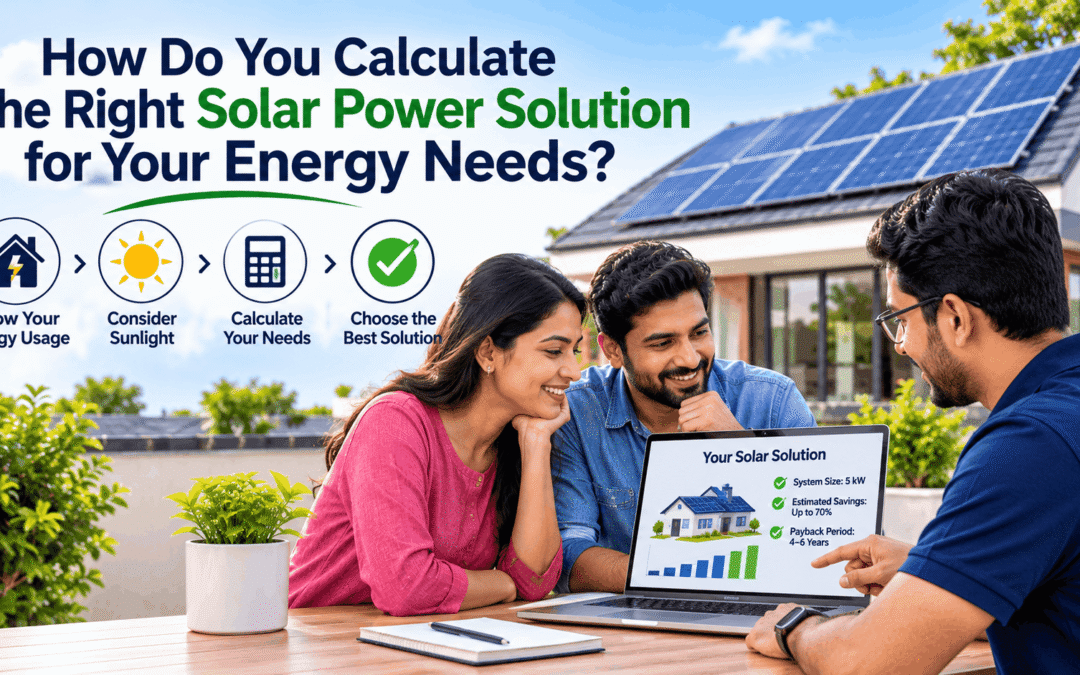
Solar energy is becoming a practical investment for homeowners, offices, shops and industries across Chennai and Tamil Nadu. With rooftop solar, you can generate your own electricity, reduce dependence on grid power and manage long-term energy expenses.
However, one important question comes before installing solar panels:
How much solar capacity do you actually need?
Some homeowners install a system that is too small to make a meaningful difference to their electricity bills. Others invest in a larger system than their property or consumption can justify. Both situations can affect the value of the investment.
The solution is to calculate your energy requirements before deciding on a solar system.
In this guide, we explain how to calculate the right solar power solution step by step, including electricity consumption, solar capacity, rooftop space, battery backup and expected savings. We also look at practical examples for Chennai homes, commercial buildings and factories.
1. Start by Understanding Your Electricity Consumption
The first step in calculating a solar system is understanding how much electricity you currently use.
Your electricity bill is the best starting point. Instead of estimating your usage based on the number of appliances in your home, review your actual consumption.
Look at the electricity units (kWh) recorded in your recent bills.
One electricity unit is equal to one kilowatt-hour (kWh).
For a more accurate estimate, collect your previous 6–12 months of electricity bills. This helps you identify changes in consumption during summer, monsoon and other seasons.
For example:
| Month | Electricity Consumption |
|---|---|
| January | 450 units |
| February | 480 units |
| March | 520 units |
| April | 620 units |
| May | 700 units |
| June | 650 units |
| Average | 570 units |
In this example, the average monthly electricity consumption is 570 units.
To calculate average daily consumption:
Average daily consumption = Monthly units ÷ 30
570 ÷ 30 = 19 units per day.
This means the property uses approximately 19 units of electricity every day.
Why Is This Important?
Electricity consumption can vary significantly between properties.
For example:
- A small apartment may use around 150–250 units per month.
- A family home with multiple air conditioners may use 500–800 units per month or more.
- A commercial office may consume several thousand units each month.
- A factory may have substantial electricity demand from motors, machinery and production equipment.
These are only illustrative consumption ranges. Your actual requirement should always be calculated from your electricity bills and operating pattern.
2. Calculate the Solar System Capacity You Need
Once you know your average daily electricity consumption, the next step is estimating the solar capacity required.
Tamil Nadu’s official rooftop solar portal states that a grid-connected rooftop solar system generally generates around 4–5 units per day for every 1 kW of installed capacity, on average.
Actual generation depends on the location, weather, panel orientation, shading, system losses and installation quality.
For an initial estimate, you can use 4.5 units per kW per day.
Solar Capacity Calculation Formula
Required solar capacity (kW) = Average daily electricity consumption (units) ÷ Expected daily generation per kW
Let’s understand this with an example.
Suppose your home in Chennai consumes 600 units per month.
Step 1: Calculate daily consumption.
600 ÷ 30 = 20 units per day.
Step 2: Use an estimated solar generation of 4.5 units per kW per day.
20 ÷ 4.5 = 4.44 kW.
Therefore, an initial estimate would be approximately 4.5 kW of solar capacity.
This is a starting estimate, not a final installation recommendation. The actual system size should also consider your daytime consumption, sanctioned load, roof conditions and applicable grid-connection rules.
Example Solar Capacity Estimates
The following table uses an illustrative generation assumption of 4.5 units per kW per day.
| Monthly Electricity Usage | Daily Consumption | Approximate Solar Capacity |
|---|---|---|
| 150 units | 5 units | 1.1 kW |
| 300 units | 10 units | 2.2 kW |
| 450 units | 15 units | 3.3 kW |
| 600 units | 20 units | 4.4 kW |
| 750 units | 25 units | 5.6 kW |
| 900 units | 30 units | 6.7 kW |
| 1,200 units | 40 units | 8.9 kW |
These are approximate planning figures. They do not guarantee that the solar system will generate exactly the same number of units every day.
3. Understand When You Use Electricity
Knowing your total monthly electricity consumption is important, but it is not enough to determine the best solar solution.
You also need to understand when you consume electricity.
Solar panels generate electricity during daylight hours. Generation generally increases after sunrise, reaches higher levels around midday and decreases towards sunset.
This means a property that consumes most of its electricity during the day may use more solar energy directly.
Consider two Chennai households:
House A:
Uses air conditioners, washing machines and other appliances during the day.
Has people working from home.
Consumes a significant amount of electricity between 9 AM and 5 PM.
House B:
Remains mostly empty during the day.
Uses air conditioners and other appliances mainly after 6 PM.
Has higher electricity consumption at night.
Both households may consume 600 units per month. However, their solar usage patterns are different.
House A may use a larger share of its solar generation directly. House B may export more surplus electricity during the day and purchase electricity from the grid at night.
This difference can affect the financial benefits of solar.
What Should You Check?
Before deciding on capacity, identify:
- How much electricity you consume during daylight hours.
- How much electricity you consume at night.
- Whether air conditioners operate during the day.
- Whether heavy appliances run during solar generation hours.
- Whether your business operates on weekdays, weekends or shifts.
For larger commercial and industrial installations, interval or time-of-day consumption data can help create a more accurate solar design.
4. Check Your Rooftop Space and Sunlight Availability
After estimating the solar capacity, check whether your rooftop can accommodate the required number of panels.
In Chennai, rooftops may have water tanks, staircases, overhead structures, neighbouring buildings and other obstructions.
These can create shadows and reduce electricity generation.
The Tamil Nadu rooftop solar portal gives an approximate requirement of 10 square metres of shadow-free roof area for a 1 kW solar system. Actual space requirements depend on panel dimensions, mounting arrangement, roof shape and access requirements.
Approximate Rooftop Space Requirements
| Solar Capacity | Indicative Shadow-Free Roof Area |
|---|---|
| 1 kW | 10 sq. m |
| 2 kW | 20 sq. m |
| 3 kW | 30 sq. m |
| 5 kW | 50 sq. m |
| 10 kW | 100 sq. m |
These are broad planning estimates rather than exact layout measurements.
Important Rooftop Factors
Roof orientation: The direction and tilt of the panels influence how much sunlight they receive.
Shading: Trees, water tanks and nearby buildings can reduce generation. Even partial shading can affect panel or string performance, depending on the system design.
Roof condition: The structure must be suitable for the additional load and mounting arrangement.
Maintenance access: Space should be available for cleaning, inspection and repairs.
Waterproofing: Mounting work should be planned carefully to avoid damaging the roof’s waterproofing.
For Chennai properties, a professional site inspection is particularly useful because rooftop conditions can differ significantly between independent houses, apartments and commercial buildings.
5. Choose the Right Type of Solar Power System
After calculating consumption and checking the rooftop, decide which type of solar system suits your requirements.
There are three common options.
On-Grid Solar System
An on-grid solar system is connected to the electricity grid.
It generates electricity during the day and supplies your building’s connected loads. Surplus electricity can be exported under the applicable Tamil Nadu billing arrangement.
When solar generation is insufficient, electricity is drawn from the grid.
This system is generally suitable for properties that want to reduce electricity bills without battery backup.
Off-Grid Solar System
An off-grid system operates independently of the electricity grid.
It uses batteries to store electricity generated during the day so that it can be used at night or when sunlight is unavailable.
It is suitable for remote properties or locations where a reliable grid connection is not available.
Hybrid Solar System
A hybrid solar system combines grid connectivity with battery storage.
It can use solar power during the day, store excess energy in batteries and draw electricity from the grid when needed.
With suitable backup functionality, it can also supply selected loads during power cuts.
This is useful for homes and businesses that want both electricity bill savings and backup power.
Which One Should You Choose?
| Your Requirement | Suitable Option to Consider |
|---|---|
| Mainly reduce electricity bills | On-grid solar |
| Operate independently of the grid | Off-grid solar |
| Reduce bills and get battery backup | Hybrid solar |
| Run selected essential appliances during outages | Hybrid solar with correctly sized backup |
| Support daytime factory consumption | On-grid rooftop solar, subject to feasibility |
The final selection should be based on your electricity usage, reliability requirements and project economics.
6. Calculate Battery Capacity If You Need Backup
If you are planning an off-grid or hybrid solar system, you must calculate battery capacity separately.
A common mistake is selecting a battery based only on the solar panel capacity. Battery storage should instead be based on the appliances you want to operate and the number of backup hours required.
Battery Calculation Formula
Required nominal battery capacity (kWh) = Backup load (kW) × Backup hours ÷ (Usable battery fraction × Inverter efficiency)
Let’s take an example.
Suppose you want to operate the following appliances during a power cut:
| Appliance | Approximate Power |
|---|---|
| 4 LED lights | 40 W |
| 3 ceiling fans | 210 W |
| Wi-Fi router | 15 W |
| 1 refrigerator | 150 W |
| Total running load | 415 W |
For simple planning, round the running load to approximately 0.5 kW.
Suppose you need 4 hours of backup.
Energy required by the appliances:
0.5 kW × 4 hours = 2 kWh.
Assume the battery has an 80% usable capacity and the inverter has 90% efficiency.
Required nominal battery capacity:
2 ÷ (0.80 × 0.90) = 2.78 kWh.
Therefore, you would initially consider a battery of approximately 2.8 kWh or higher, subject to the manufacturer’s specifications and actual operating loads.
This is only an illustrative calculation. Refrigerator compressors, motors and air conditioners can have starting-power requirements, and actual consumption changes with operating conditions.
For reliable backup, the installer should also check inverter output capacity, battery discharge limits and the loads connected to the backup circuit.
7. Estimate How Much Electricity Your Solar System Can Generate
Once you have an approximate system capacity, you can estimate its monthly electricity generation.
Solar Generation Formula
Estimated monthly generation = Solar capacity (kW) × Average daily generation per kW × 30
For example, consider a 5 kW rooftop solar system.
Assume average generation of 4.5 units per kW per day.
5 × 4.5 × 30 = 675 units per month.
The system may therefore generate approximately 675 units in an average month under this planning assumption.
However, actual monthly generation can vary due to:
- Cloud cover and seasonal weather.
- Rainfall and monsoon conditions.
- Dust and dirt accumulation on panels.
- Rooftop orientation and tilt.
- Shading from nearby structures.
- Inverter and electrical system losses.
- Equipment performance and temperature.
Chennai receives strong sunlight for much of the year, but solar generation is not identical every month. A realistic project estimate should include seasonal variations rather than assuming the same generation throughout the year.
8. Calculate Your Potential Electricity Bill Savings
Solar capacity and electricity generation are only part of the calculation. You should also understand how much of that generation can reduce your actual electricity expenses.
A grid-connected solar system generally provides two ways to account for solar electricity:
- Electricity consumed directly by your property.
- Surplus electricity exported to the grid and credited according to the applicable billing arrangement.
These two forms of solar energy may not have the same financial value.
Example: Monthly Savings Calculation
Suppose a Chennai home has:
- Monthly electricity consumption: 750 units.
- Solar system capacity: 5 kW.
- Estimated monthly solar generation: 675 units.
- Direct solar consumption: 70% of generation.
- Assumed electricity value for illustration: ₹6 per unit.
Step 1: Calculate solar electricity used directly.
675 × 70% = 472.5 units.
Step 2: Calculate the illustrative value of direct solar consumption.
472.5 × ₹6 = ₹2,835.
The estimated value of directly consumed solar electricity is therefore ₹2,835 per month.
The remaining 202.5 units may be exported if the system is grid-connected and the applicable arrangement permits it.
However, the value of exported electricity must be calculated separately using the relevant Tamil Nadu settlement rules and tariff.
This example is not a guaranteed saving or an actual electricity tariff quotation. Your final bill reduction depends on tariff category, consumption slabs, fixed charges, export credits, network charges where applicable and the billing arrangement.
Important: Solar Does Not Always Make Your Electricity Bill Zero
Even when your solar system generates as many units as you consume over a month, your bill may not become zero.
This is because electricity billing can include different components, and exported electricity may not receive the same value as electricity consumed directly.
For homes, offices and factories, the financial calculation should be based on the actual tariff and settlement arrangement rather than simply multiplying all solar units by a single electricity rate.
9. Calculate Solar Requirements for Offices and Commercial Buildings
Commercial buildings often have different consumption patterns from residential properties.
Offices, hospitals, shopping complexes, educational institutions and hotels may consume substantial electricity during working hours.
This can make rooftop solar a practical option because electricity generation and building consumption may occur at similar times.
Example: Office Building
Suppose an office in Chennai consumes 3,000 units per month.
Average daily consumption:
3,000 ÷ 30 = 100 units.
Estimated solar capacity:
100 ÷ 4.5 = 22.2 kW.
An initial estimate would be approximately 22–23 kW.
However, before installing this capacity, the building owner should check:
- Daytime electricity consumption.
- Air-conditioning operating hours.
- Computer and server loads.
- Weekend and holiday consumption.
- Sanctioned load and grid-connection feasibility.
- Available rooftop area.
- Applicable commercial electricity tariff and export settlement.
If the office consumes most of its electricity during the day, a grid-connected rooftop system may offer a useful reduction in purchased electricity.
If uninterrupted power is required for servers or other essential equipment, a hybrid system or a separate backup arrangement may also be evaluated.
10. Calculate Solar Requirements for Factories and Industries
Industrial solar projects require more detailed planning because electricity consumption can vary significantly between production processes.
A factory in Ambattur, Guindy, Sriperumbudur, Oragadam or Maraimalai Nagar may use electricity for:
- Production machinery.
- Motors and pumps.
- Air compressors.
- Industrial cooling systems.
- Lighting and ventilation.
- Material handling equipment.
- Administrative buildings.
For factories, the solar system should be designed around actual operating hours and load profiles.
Example: Industrial Facility
Suppose a factory consumes 30,000 units per month.
Average daily consumption:
30,000 ÷ 30 = 1,000 units.
Estimated solar capacity:
1,000 ÷ 4.5 = 222.2 kW.
An initial estimate would be approximately 222 kW.
But this does not mean a 222 kW system should automatically be installed.
An industrial feasibility study should also consider:
- Daytime load: How much electricity does the factory consume while the solar plant is generating?
- Shift timings: Does the factory operate during one shift, two shifts or continuously?
- Weekend operations: Is electricity consumed on Sundays and public holidays?
- Sanctioned demand: Does the proposed capacity meet the relevant electrical and regulatory requirements?
- Roof condition: Can the roof safely accommodate the panels and mounting structure?
- Export arrangements: How will surplus electricity be treated under the applicable regulations?
- Demand charges: What portion of the electricity bill is linked to demand rather than energy consumption?
For larger industrial consumers, the project may also require a comparison between rooftop solar, ground-mounted captive solar and other eligible procurement arrangements.
11. Understand the Electricity Bill Before Calculating Return on Investment
A common mistake is calculating solar savings using only the total amount paid on an electricity bill.
The bill may contain multiple components, such as:
- Energy charges.
- Fixed or demand-related charges.
- Electricity duty and applicable taxes.
- Power factor-related charges, where applicable.
- Metering and other applicable charges.
- Export credits or settlement adjustments.
A rooftop solar system primarily reduces electricity purchased from the grid. It does not automatically eliminate every bill component.
For residential consumers, the impact depends on the applicable tariff and billing rules.
For commercial and industrial consumers, demand charges and operating patterns can have a significant impact on overall savings.
Therefore, a proper solar feasibility report should compare your existing electricity bill with an estimated post-solar bill.
12. Estimate the Payback Period of Your Solar Investment
After estimating the installation cost and annual savings, you can calculate the approximate payback period.
Simple Payback Formula
Payback period = Initial solar investment ÷ Estimated annual net savings
For example:
Total installed system cost: ₹3,00,000.
Estimated annual electricity bill savings: ₹60,000.
Payback period:
₹3,00,000 ÷ ₹60,000 = 5 years.
The estimated simple payback period is 5 years.
However, this is an illustrative calculation. A realistic financial analysis should also consider:
- Eligible government subsidies.
- Financing costs and loan interest.
- Annual solar generation changes.
- Electricity tariff changes.
- System maintenance.
- Inverter or battery replacement.
- Export credit rates.
- Applicable taxes and charges.
For a more accurate comparison, ask your solar installer to provide an annual savings estimate and a project cash-flow analysis rather than relying only on a simple payback figure.
13. Check Government Subsidy and Tamil Nadu Solar Regulations
If you are a homeowner in Tamil Nadu, government subsidy may reduce the initial cost of an eligible residential rooftop solar installation.
The central government’s PM Surya Ghar: Muft Bijli Yojana and Tamil Nadu’s rooftop solar programme provide assistance subject to their current eligibility conditions.
The Tamil Nadu Solar Homes Portal currently provides information about central and state assistance, eligible system capacities, empanelled vendors and application procedures.
For eligible residential households, the portal describes total financial assistance of up to ₹1 lakh, subject to scheme conditions and successful installation, metering and commissioning.
Commercial and industrial consumers should not assume that residential subsidy benefits apply to their projects.
Before finalising your system, check:
- Your consumer category.
- Sanctioned load and proposed solar capacity.
- Grid-connection feasibility.
- Applicable metering and billing arrangements.
- Subsidy eligibility, if relevant.
- Vendor empanelment and equipment requirements.
Official resources:
- Tamil Nadu Solar Homes Portal: https://www.tnebltd.gov.in/usrp/
- PM Surya Ghar National Portal: https://pmsuryaghar.gov.in/
- TNPDCL solar rooftop application portal: https://www.tnebltd.gov.in/usrp/index.xhtml
14. Common Mistakes to Avoid When Calculating Solar Capacity
Before selecting a solar system, be careful about these common mistakes.
1. Using Only One Electricity Bill
One month’s consumption may not represent your actual annual usage. Review several months of bills to understand seasonal changes.
2. Selecting Solar Capacity Only Based on Roof Space
A large rooftop does not automatically mean you need a large solar installation. Capacity should match consumption, grid feasibility and financial requirements.
3. Ignoring Daytime Electricity Usage
Solar generation is highest during daylight hours. If your property consumes most electricity at night, you should evaluate the value of exported energy and whether battery storage is worthwhile.
4. Forgetting Battery Requirements
If you need backup, calculate the essential load and backup duration before choosing battery capacity.
5. Expecting the Same Generation Every Month
Solar generation changes with weather, sunlight availability, shading and system performance. Use realistic monthly estimates.
6. Ignoring Sanctioned Load and Approval Requirements
The proposed system must comply with the applicable utility and regulatory requirements. Confirm feasibility before installation.
7. Choosing the Cheapest Quotation
Check panel specifications, inverter quality, mounting structure, electrical safety, warranty and after-sales support. A technically suitable installation is more important than choosing the lowest price.
15. How Kinetiq Energy Can Help You Calculate the Right Solar Solution
Calculating solar capacity is not simply about dividing your monthly electricity units by an estimated generation figure. A good solar design also considers the way you use electricity, your rooftop conditions, grid requirements and long-term financial goals.
At Kinetiq Energy, the objective is to help homeowners and businesses understand their solar requirements and identify suitable solar power solutions.
Whether you are planning a rooftop solar system for an independent house, apartment, office, commercial building or factory in Chennai, a proper assessment should consider:
- Your recent electricity bills.
- Average monthly and daily consumption.
- Daytime and nighttime electricity usage.
- Available shadow-free rooftop space.
- Solar capacity and inverter requirements.
- Battery backup requirements, if needed.
- Applicable grid approvals and billing arrangements.
- Estimated generation and potential savings.
Instead of choosing a system based only on a salesperson’s recommendation, understand the calculations behind the proposal.
Frequently Asked Questions (FAQs)
1. How do I calculate how many kW of solar panels I need?
First, calculate your average daily electricity consumption by dividing your monthly units by 30. Then divide that figure by the expected daily generation per kW. For an initial Tamil Nadu estimate, you can use approximately 4.5 units per kW per day, subject to site conditions.
2. How many units does a 1 kW solar system generate in Chennai?
Tamil Nadu’s official rooftop solar portal indicates an average generation of around 4–5 units per day per kW. Actual generation varies with weather, shading, orientation and system performance.
3. How much rooftop space is required for a 5 kW solar system?
As a broad planning estimate, a 5 kW rooftop solar system may require approximately 50 square metres of shadow-free space. The actual requirement depends on panel dimensions, mounting design, roof layout and maintenance access.
4. Can I install a 3 kW solar system if my house consumes 500 units per month?
A 3 kW system may generate approximately 360–450 units per month using the indicative Tamil Nadu generation range. However, it may not cover all your consumption, and the financial benefit depends on when you use electricity and how exported power is settled.
5. Is a battery necessary for a rooftop solar system?
No. A conventional on-grid solar system does not normally require a battery. Batteries are needed for off-grid systems and for hybrid systems that provide stored-energy backup.
6. How do I calculate battery capacity for solar backup?
Multiply the combined backup load in kW by the required backup hours. Divide the result by the usable battery fraction and inverter efficiency to estimate the nominal battery capacity required.
7. Can a factory use solar power to reduce its electricity bill?
Yes. Factories can use rooftop or other eligible solar arrangements to reduce electricity purchased from the grid. The appropriate capacity depends on daytime consumption, production schedules, sanctioned demand, available space and applicable regulations.
8. Will a solar system completely eliminate my EB bill?
Not necessarily. Your bill may still include fixed, demand-related or other applicable charges. Export credits and energy charges are also governed by the applicable billing arrangement.
9. Is government subsidy available for solar installations in Tamil Nadu?
Eligible residential rooftop installations may qualify for assistance under PM Surya Ghar and the Tamil Nadu programme, subject to current scheme conditions. Commercial and industrial projects have different eligibility arrangements.
10. Should I install a larger solar system for future electricity needs?
If you expect your electricity consumption to increase, discuss the future requirement with your installer. However, the proposed capacity must also satisfy technical, financial and regulatory requirements. It is better to plan for realistic future demand than to install excess capacity without a clear benefit.