

Installing rooftop solar is a major decision for any homeowner or business. The right system can help reduce electricity bills, make better use of available roof space and provide long-term value. However, the results depend on more than the solar panels themselves. The company you choose, the quality of the installation and the support you receive after commissioning all matter.
For homeowners in Chennai, choosing a solar installation company requires a little extra attention. Strong sunlight creates good potential for solar power, but high temperatures, coastal weather, roof conditions, electricity consumption patterns and local approval procedures must all be considered.
A company offering the lowest quotation may not necessarily be the best choice. Before paying an advance or signing a contract, use the following checklist to compare solar installers and understand what you are actually paying for.
1. Check the Company’s Experience and Credentials
Start by understanding who will install your solar system and whether the company has the technical experience to complete the work properly.
A professional solar installation company should be able to explain its experience with residential rooftops, apartment buildings or commercial properties, depending on your requirements. Ask how many similar installations it has completed and whether it can share photographs, project details or customer references.
Here are a few questions worth asking:
- How long has the company been installing solar systems?
- Does it have experience with properties similar to yours?
- Who will carry out the electrical work and commissioning?
- Does it use trained installation technicians?
- Can it provide a written quotation, invoice and installation agreement?
If you are planning to install solar on a house in Chennai, experience with independent residential rooftops can be particularly useful. An installer working on a factory roof may have different expertise from one specialising in smaller residential systems.
Practical tip: Do not rely only on photographs or social media testimonials. If possible, speak to a previous customer and ask about installation quality, communication, paperwork and service after the system was switched on.
2. Verify Vendor Eligibility and Government Scheme Requirements
If you are planning to use a government subsidy, this check is essential.
Under the PM Surya Ghar: Muft Bijli Yojana, eligible residential consumers can apply for central financial assistance through the official process. The installation must satisfy the applicable scheme requirements, including vendor-related and distribution-company verification procedures. The Ministry of New and Renewable Energy provides the scheme information, while Tamil Nadu has its own rooftop solar portal for applications and related procedures.
Before hiring an installer, check:
- Whether the company is currently eligible or empanelled for the specific scheme you intend to use.
- Whether your electricity connection and property qualify.
- Whether the proposed equipment and installation meet applicable requirements.
- Who will handle the application, documentation and inspection process.
- What payments are due before and after installation verification.
Do not assume that every solar company can arrange a subsidy for every customer. Eligibility depends on the applicable scheme rules and your circumstances. Confirm the current requirements through the official portal before making a financial commitment.
Also, be cautious of anyone promising guaranteed subsidy approval or asking you to rely entirely on verbal assurances.
3. Ask for a Proper Rooftop Inspection
A reliable installer should assess your property before recommending a system size. A quotation prepared without understanding your roof may not reflect the actual work required.
For a Chennai home, the inspection should consider:
- Available roof area and the roof’s structural condition.
- Shade from neighbouring buildings, trees, water tanks and overhead structures.
- Roof orientation, panel arrangement and potential energy generation.
- Safe access for installation, inspection and cleaning.
- Mounting arrangements and protection against water leakage.
- Cable routing, inverter location and electrical connection requirements.
Chennai properties vary considerably. An independent house in Tambaram may have a different layout from a compact home in Velachery or a multi-storey building in Anna Nagar. The installation plan should reflect those differences.
For older buildings or roofs with signs of damage, ask whether additional structural assessment is needed. Solar panels and mounting structures add load to the roof, so structural suitability should not be assumed without checking.
A professional site survey should result in a clear system layout, not just a verbal statement that your roof is suitable.
4. Make Sure the System Size Matches Your Electricity Usage
Bigger does not automatically mean better.
The right solar system depends on how much electricity you use, when you use it, the space available and the applicable connection and grid rules. An oversized system may cost more than necessary, while an undersized system may not deliver the savings you expect.
Before recommending a 3 kW, 5 kW or 10 kW system, the installer should review your recent electricity bills and understand your usage.
For example:
- A household that uses air conditioners mainly during the day may benefit from a different system design than a household whose major consumption occurs at night.
- A home with multiple air conditioners, a water pump and several other appliances may require a larger system than a smaller household.
- A commercial property operating primarily during daylight hours may be able to use more of its solar generation directly.
Ask the company to explain why it has recommended a particular capacity. It should also explain the assumptions behind its generation estimate and whether the proposed capacity is compatible with your sanctioned load, connection type and applicable distribution-company rules.
A good installer designs around your electricity needs rather than simply selling the largest system possible.
5. Compare Solar Panel Quality, Inverters and Other Equipment
Solar panels are important, but they are only one part of the system. The inverter, mounting structure, wiring, protection devices and monitoring equipment also affect performance and reliability.
Request a written list of the equipment included in the quotation. It should identify the manufacturer, model, specifications and warranty terms wherever applicable.
Solar panels
Check the panel manufacturer’s identity, product specifications, warranty conditions and applicable Indian quality requirements. For installations where scheme or regulatory rules require particular models or manufacturers, verify those requirements rather than relying on a sales representative’s assurance.
MNRE publishes information on the Approved List of Models and Manufacturers (ALMM) and related quality-control requirements.
Solar inverter
The inverter converts the electricity generated by the panels into usable power. Ask which model is proposed, whether it is suitable for the system design and what warranty and service support are available.
Mounting structure
The structure should suit your roof and be designed for local environmental conditions. Ask about the mounting material, corrosion protection, anchoring method and how the installer intends to protect the roof from water ingress.
Cables and electrical protection
The quotation should clearly include suitable solar cables, connectors, earthing and the required protective devices. The exact design depends on the system and site conditions.
Do not compare two quotations only by the total number of panels or the headline system capacity. Compare the complete equipment list and installation scope.
6. Understand How the Company Estimates Solar Savings
One of the most important questions to ask is: “How much can this system realistically reduce my electricity bill?”
A responsible solar installer should explain its assumptions instead of promising a fixed saving without analysing your usage.
Ask for a generation estimate that accounts for:
- Proposed system capacity.
- Roof direction, tilt and shading.
- Expected local solar conditions.
- Equipment performance and system losses.
- Your electricity consumption pattern.
- The rules applicable to energy exported to the grid.
For Chennai homes, hot weather and strong sunlight can support good solar generation, but actual output varies with system design, weather, shading, equipment and maintenance.
It is also important to distinguish between solar electricity you consume directly and electricity exported to the grid. The financial value of exported power depends on the applicable tariff and billing arrangement.
A solar system does not automatically make every electricity bill zero. Fixed charges, other applicable charges, night-time consumption and the treatment of exported electricity can affect the final bill.
Ask for a written estimate showing the expected generation and the assumptions used to calculate savings. If a company guarantees a specific monthly saving without reviewing your bills or roof, request a clearer explanation before proceeding.
7. Check Net-Metering and Electricity-Board Support
For grid-connected rooftop solar, the connection and metering process is an important part of the project.
In Tamil Nadu, you should understand the applicable procedure for your electricity connection before installation begins. Depending on the project, the process may involve an application, technical details, documentation, installation verification and metering-related steps.
Ask the installer:
- Will you help with the required application and documentation?
- Who is responsible for submitting technical information?
- What approvals or checks are required before the system can operate under the intended arrangement?
- Who coordinates with the distribution company about the meter?
- What happens if an application or inspection identifies a problem?
The Tamil Nadu rooftop solar portal provides information on applications, vendor empanelment, net-meter-related documents and scheme procedures.
Make sure the quotation explains which approvals and services are included in the price. Do not assume that a system is fully commissioned simply because the panels and inverter have been installed on the roof.
8. Read the Warranty Terms Carefully
Solar systems are designed for long-term use, so warranty coverage matters.
However, there is no single warranty period that applies to every component or every installation. The coverage depends on the product, manufacturer, contract and applicable terms.
Before signing, ask for written details covering:
- Solar panel product warranty and performance warranty.
- Inverter warranty and available service arrangements.
- Mounting structure and workmanship coverage.
- Coverage for installation-related issues and roof leakage, if offered.
- Warranty exclusions and conditions that could affect a claim.
- The procedure for raising a service request.
Ask who will handle a warranty claim. Will you contact the installer, the equipment manufacturer or a separate service provider?
Also, clarify whether labour, travel, removal and reinstallation costs are covered if equipment needs to be replaced. These details can make a significant difference when a problem occurs.
Do not rely on a salesperson saying, “Everything is covered.” Ask for the actual warranty documents and read the conditions.
9. Confirm After-Sales Service and Maintenance
Solar panels generally require less routine maintenance than many conventional power systems, but they are not completely maintenance-free.
Dust, bird droppings, leaves and other deposits can affect output. Chennai rooftops may also experience coastal moisture, strong sun and seasonal rain. The maintenance approach should suit the installation environment.
Ask the company whether it offers:
- System performance monitoring.
- Guidance on safe panel cleaning.
- Periodic inspection, if required.
- Inverter fault diagnosis and troubleshooting.
- Electrical safety checks.
- A clear contact point for service requests.
Find out whether maintenance is included in the quotation, offered under a separate contract or charged on a visit-by-visit basis.
You should also receive basic instructions on monitoring your system and identifying unusual changes in performance. A dependable installer explains how to seek help after commissioning rather than disappearing once the final payment is made.
10. Compare Written Quotations, Not Just Prices
It is sensible to obtain at least two or three comparable quotations before making a decision.
However, a lower quotation may leave out important items that another company has included. Ask each installer to quote for the same approximate capacity and to specify the equipment, installation scope and services included.
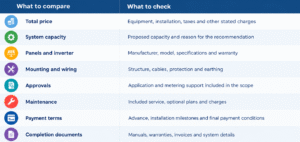
Request a written explanation of any significant price difference. It may be due to equipment specifications, roof complexity, additional electrical work or differences in the scope of service.
Avoid making a decision based only on a verbal promise of a discount or an estimated subsidy deduction.
11. Make Sure the Contract Protects You
Before paying an advance, read the quotation and installation agreement carefully.
The document should identify the company, proposed equipment, total cost, payment schedule, expected project stages, warranty terms and responsibilities of both parties.
It should also clarify how changes in scope will be handled and what happens if delays or technical issues arise.
Check that you understand:
- What is included and excluded from the price.
- Who is responsible for approvals and documentation.
- What conditions must be met before final payment.
- How defects or incomplete work will be addressed.
- What documentation you will receive at handover.
Avoid paying the full amount upfront without a clear written agreement and a reasonable payment structure. Keep invoices, receipts, approval records and communications in one place.
12. Look for Real Customer Feedback and Local Service Capability
A solar installation is a long-term investment, so the company’s ability to support its customers after installation is just as important as its sales presentation.
Look beyond star ratings. Read reviews that discuss installation quality, communication, warranty claims and the response to technical problems.
If possible, ask for references from customers in Chennai or nearby areas. A completed installation in a similar type of property can help you understand what to expect.
Useful questions include:
- Was the installation completed as agreed?
- Were the final costs consistent with the quotation?
- Did the company explain the system clearly?
- Was the paperwork handled properly?
- Did the company respond when the customer needed service?
A company does not have to be the largest in the market to be a good choice. What matters is whether it can demonstrate relevant experience, sound technical practices, transparent pricing and dependable support.
13. Watch Out for These Warning Signs
Be cautious if a solar installer:
- Promises a zero electricity bill without reviewing your usage and billing arrangement.
- Guarantees subsidy approval regardless of eligibility.
- Refuses to provide an itemised quotation.
- Cannot identify the proposed panel and inverter models.
- Recommends a system without inspecting the roof or reviewing electricity bills.
- Gives unclear or contradictory warranty information.
- Pressures you to pay immediately to secure a supposedly limited offer.
- Avoids explaining who will handle approvals and after-sales service.
One warning sign does not automatically prove that a company is unreliable, but it is a reason to ask further questions and verify its claims.
14. Why Chennai Homeowners Need a Localised Solar Assessment
Solar installation is not a one-size-fits-all service. A good design should consider your property, consumption and local conditions.
For example, a home in Chennai with several air conditioners may have a different usage profile from a home occupied mainly in the evening. An apartment association may need to consider shared-area consumption, available common roof space and the permissions required for the building. A factory may need a more detailed assessment of daytime demand, electrical infrastructure and operating requirements.
Local weather and coastal exposure also make equipment selection, mounting quality, cable routing and maintenance planning important.
Before choosing a company, make sure it understands your actual situation rather than offering the same package to every customer.
15. How Kinetiq Energy Can Help With Your Solar Decision
If you are exploring rooftop solar for your home or business in Chennai, Kinetiq Energy is one option to consider when comparing installers.
Visit KinetiQ Energy to learn more about the company’s solar offerings and enquire about a system assessment.
When discussing your project with Kinetiq Energy-or any other installer-ask for a clear explanation of the proposed system size, equipment specifications, expected generation, installation scope, applicable approvals and warranty coverage. Compare the answers against other written quotations before making a decision.
The aim should not simply be to install solar panels. It should be to choose a suitable system that delivers value over time and has reliable support behind it.
Frequently Asked Questions
1. How do I choose the best solar installation company in Chennai?
Compare the company’s relevant experience, vendor eligibility where applicable, equipment specifications, site-inspection process, written quotation, warranty coverage and after-sales support. Speak with previous customers if possible and compare complete quotations rather than headline prices alone.
2. Is the cheapest solar installation quotation the best option?
Not necessarily. A lower price may reflect different equipment, a smaller installation scope or fewer included services. Compare the system capacity, panel and inverter models, mounting structure, safety components, paperwork, warranties and maintenance arrangements before deciding.
3. Can I get a government subsidy for rooftop solar in Chennai?
Eligible residential consumers may qualify for assistance under the applicable PM Surya Ghar scheme. Eligibility, approved installation requirements and application procedures must be checked through the official national and Tamil Nadu portals. Do not assume that every property or electricity connection qualifies.
4. How do I know what solar system size my home needs?
Start with recent electricity bills, your consumption pattern, available roof space and the technical limits of your connection. Ask the installer to explain its capacity recommendation and provide a generation estimate with clear assumptions.
5. Does rooftop solar eliminate the entire electricity bill?
Not always. Your final bill depends on how much electricity you consume, how much solar power you generate and use, the applicable export arrangement and other charges. Ask the installer to explain the expected bill impact for your specific connection.
6. What documents should I receive after installation?
Depending on the project and applicable requirements, you should obtain the invoice, equipment details, warranty documents, system information, operating instructions and relevant approval or metering records. Confirm the exact handover documents with the installer before the project begins.
7. How often do solar panels need cleaning?
Cleaning frequency depends on dust, bird activity, weather and the roof environment. Ask your installer for a site-specific maintenance recommendation. Cleaning should be carried out safely, following the equipment guidance and avoiding unsafe access or unsuitable cleaning methods.