

For businesses in Chennai, electricity is more than just a monthly expense. It is an important part of running a factory, office, warehouse, showroom, hotel or commercial building efficiently.
As electricity consumption grows, many business owners are exploring rooftop solar to reduce their power costs and improve long-term energy planning. Chennai receives substantial sunshine throughout the year, making solar worth evaluating for many commercial and industrial properties.
However, choosing solar is not simply about purchasing panels and installing them on the roof. The company you select can influence the system’s performance, installation quality, safety, maintenance requirements and overall financial returns.
A quotation that looks attractive today may not be the best investment if it overlooks your actual electricity consumption, roof condition, electrical infrastructure or future business requirements.
So, how do you choose the right solar installation company for your business in Chennai?
The answer is to look beyond the initial price and evaluate the company’s technical knowledge, project experience, equipment quality, financial calculations and commitment to service after installation.
1. Choose a Company That Understands Your Business Requirements
Every business has a different electricity consumption pattern. A manufacturing unit operating multiple shifts will have different requirements from an office that mainly consumes electricity during daytime working hours.
Similarly, a warehouse, hospital, hotel, textile unit and IT office may have different load profiles, operating schedules and energy requirements.
A reliable solar installation company should understand how your business uses electricity before recommending a system.
During the initial discussion, the company should ask questions such as:
- What is your average monthly electricity consumption?
- What are your current electricity charges?
- How many hours does your business operate each day?
- Does your facility operate during the daytime, at night or across multiple shifts?
- What is your sanctioned load or contracted demand?
- Is your electricity connection low tension (LT) or high tension (HT)?
- Are you planning to expand your facility or add machinery?
- Do you have sufficient rooftop or other suitable space for solar?
These questions help determine whether rooftop solar is appropriate and how the proposed system should be designed.
A good solar company recommends a system based on your business requirements-not simply the largest system that can fit on your roof.
2. Check the Company’s Experience With Commercial and Industrial Projects
Installing solar for a business is different from installing a small residential system.
Commercial and industrial projects may involve larger electrical loads, complex roof layouts, structural assessments, multiple distribution boards, HT or LT connections, shutdown coordination and additional safety requirements.
Before choosing an installer, ask about its experience with projects similar to yours.
For example, if you operate a factory in Ambattur, Guindy, Sriperumbudur, Oragadam or another industrial area around Chennai, ask whether the company understands the practical requirements of industrial solar installations.
Useful questions include:
- Have you completed projects for factories or commercial buildings?
- Can you share references for comparable installations?
- Who will handle the engineering and electrical design?
- How will installation work be coordinated with our operations?
- Can you explain the expected energy generation and project economics?
- Who will be responsible for maintenance and troubleshooting?
A company that has handled similar projects is more likely to anticipate site-specific challenges.
However, do not judge experience only by the number of projects advertised on a website. Ask for verifiable references, project details and, where possible, permission to speak with previous customers.
3. Understand Whether the Company Provides Complete EPC Services
In solar, EPC stands for Engineering, Procurement and Construction.
A solar EPC company typically coordinates the technical design, equipment procurement, installation, testing and commissioning of a solar power system.
For a business owner, dealing with a company that takes responsibility for the complete project can simplify coordination.
Depending on the agreed scope, the EPC provider may handle:
- Site assessment and feasibility studies
- Electricity consumption analysis
- Roof and structural assessment coordination
- Solar system design and engineering
- Module, inverter and mounting structure selection
- Electrical cabling, protection and earthing
- Installation and testing
- Utility approvals and metering coordination, where included
- System commissioning and handover documentation
- Monitoring and maintenance services, where contracted
Not every installer offers all these services. Some companies outsource parts of the work or supply equipment without managing the complete project.
That is not automatically a problem, provided responsibilities are clearly defined.
Before signing the agreement, ask for a written scope of work. It should identify what is included, what is excluded, who handles approvals and who is accountable if a project milestone is delayed.
4. Evaluate the Quality of Solar Panels and Inverters
Solar panels and inverters are among the most important components of your investment.
The panels convert sunlight into direct-current electricity, while the inverter converts that electricity into alternating current suitable for the building’s electrical system.
The quality, suitability and correct installation of these components can affect system performance and reliability.
When comparing solar installation companies, request the following information.
Solar panels
Check the manufacturer, exact model, rated capacity, applicable Indian standards and product documentation. Ask about the product warranty and the manufacturer’s performance warranty, including the conditions under which claims are handled.
Inverters
Check the inverter brand, model, capacity, efficiency, protection features, monitoring capability and warranty. The inverter should be suitable for your system design and electrical connection.
Mounting structures
Ask about the material, corrosion protection, wind-load design and fixing method. This is particularly relevant in coastal Tamil Nadu, where humidity and corrosive conditions can affect unsuitable materials and poorly protected metalwork.
Electrical components
Review the specifications for cables, connectors, switchgear, protection devices, earthing and other balance-of-system components.
The Ministry of New and Renewable Energy publishes information on solar equipment standards and quality-control requirements. Your installer should be able to provide appropriate compliance documentation for the equipment proposed for your project.
Do not select equipment based on brand names alone. Ask the installer to explain why the proposed components suit your site, operating conditions and budget.
5. Ask for a Proper Site Inspection Before Accepting the Quote
A professional solar installation company should not finalise a complex commercial project based only on a few photographs or a brief phone conversation.
A site assessment helps the engineering team understand the real installation conditions.
For a Chennai business, the assessment should consider:
- Available roof area and roof condition
- Shading from nearby buildings, trees and rooftop equipment
- Roof orientation and suitable panel arrangement
- Structural suitability for the proposed mounting system
- Water drainage and waterproofing considerations
- Cable routes and inverter location
- Existing electrical infrastructure
- Earthing and electrical protection requirements
- Safe access for installation and maintenance
- Site-specific wind and corrosion considerations
Factories may also have dust, fumes, vibration, high-temperature areas or operational restrictions that affect equipment placement and maintenance.
For older industrial buildings, structural suitability deserves particular attention before mounting panels.
The company should use the assessment to develop a practical layout and explain any limitations. If structural strengthening, waterproofing repairs or electrical upgrades are required, those costs should be identified rather than appearing as unexpected expenses later.
6. Compare Solar Quotations Properly-Not Just by Price
One of the most common mistakes businesses make is selecting the lowest quotation without checking what it includes.
Two proposals may quote the same solar capacity but differ substantially in equipment specifications, engineering quality, installation scope, warranties and service commitments.
For a fair comparison, ask every shortlisted company to quote against a similar scope.
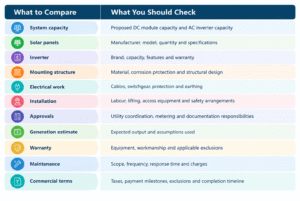
Ask for a detailed bill of quantities or equipment schedule wherever appropriate.
A low quotation may be reasonable if the company has an efficient procurement process. But if it excludes important electrical work, structural changes or commissioning activities, the final cost could be higher than expected.
The right comparison is between complete, technically suitable proposals-not merely the final numbers on three quotations.
7. Check Whether the Company Understands Tamil Nadu’s Electricity Rules
This is especially important for commercial and industrial solar projects.
The best system for your business depends not only on sunlight and roof area but also on your electricity connection, applicable tariff, sanctioned load or contracted demand, metering arrangement and utility requirements.
Tamil Nadu has a regulatory framework for grid-connected solar photovoltaic systems. The applicable arrangements can differ according to consumer category, project capacity and the current rules.
Before proceeding, ask the installer to explain:
- Which metering arrangement applies to your project?
- What approvals are required from the electricity utility?
- Does the proposed capacity comply with applicable technical and regulatory limits?
- Are there any network, metering or other charges relevant to the project?
- How will surplus generation be treated?
- Will the system affect your existing demand charges or contracted demand?
- What documents and inspections are needed before commissioning?
Do not assume that surplus electricity exported to the grid will automatically earn the same value as electricity purchased from the utility.
The treatment of imported and exported energy depends on the applicable arrangement and current rules. This can materially affect your savings calculation.
For official information, refer to the Tamil Nadu Electricity Regulatory Commission and Tamil Nadu’s rooftop solar portal
A capable installer should explain the relevant process for your project and verify current requirements rather than relying on general claims.
8. Make Sure the Savings Calculation Is Based on Your Actual Electricity Bill
For a business, the financial benefit of solar is often one of the biggest reasons for investing.
However, a realistic savings estimate requires more than multiplying the system capacity by an assumed number of units.
Ask the company to review your recent electricity bills and, where available, interval or load-profile data.
The analysis should consider:
- Monthly electricity consumption
- Daytime consumption and operating hours
- Applicable energy charges
- Demand charges and contracted demand
- Time-of-day tariffs, if applicable
- Expected solar generation
- Self-consumption of solar electricity
- Exported energy and the applicable credit mechanism
- System losses and equipment downtime
- Operations and maintenance costs
- Applicable taxes, charges and financing costs
For example, a factory that consumes most of its electricity during sunny daytime hours may be able to use a substantial share of its solar generation directly.
A facility that operates mainly at night may need a different analysis, even if its total monthly consumption is high.
A well-prepared proposal should explain the assumptions behind the estimated savings and distinguish between projected generation, avoided electricity costs and any revenue or credit from exported energy.
Be cautious if a company guarantees a very short payback period without reviewing your actual bills or explaining its calculations.
9. Ask for a Transparent Return-on-Investment Calculation
Solar is a long-term business investment. You should understand how the project is expected to perform financially before committing capital.
Ask the installer to provide a financial model that includes the total installed cost, estimated annual generation, expected savings, operating costs and major assumptions.
A basic simple-payback estimate can be expressed as:
Simple payback period = Initial net investment ÷ Estimated annual net savings
For example, if the initial net investment is ₹20 lakh and the estimated annual net savings are ₹4 lakh, the simple payback is five years.
This is only an illustration, not a forecast for your business. Your actual result will depend on the project cost, tariff structure, self-consumption, export treatment, financing, system performance and operating expenses.
For a more complete decision, ask about:
- Annual performance assumptions
- Panel degradation
- Inverter replacement assumptions
- Maintenance and cleaning costs
- Financing interest and repayment
- Changes in electricity tariffs
- Expected project life
- Sensitivity to lower-than-expected generation
For larger projects, a discounted cash-flow analysis and net present value calculation can provide a more useful picture than simple payback alone.
The goal is not to find the most optimistic financial projection. It is to understand whether the project remains worthwhile under reasonable operating conditions.
10. Examine Warranties and After-Sales Support
Solar installations are designed to operate over many years. What happens after commissioning is therefore just as important as the installation itself.
Before signing the contract, ask for written details of the warranties and service arrangements.
Clarify the difference between:
- Solar module product warranty
- Solar module performance warranty
- Inverter warranty
- Mounting structure warranty, where provided
- Installation workmanship warranty
- Monitoring and maintenance service commitments
These warranties are not interchangeable. A performance warranty, for instance, is not the same as a warranty against a manufacturing defect.
Ask who will process warranty claims, whether labour and transport are covered, and what happens if a component fails.
For maintenance, confirm whether the agreement includes panel cleaning, electrical inspections, inverter checks, performance monitoring and fault response. Also establish the annual charges and response times.
For businesses around Chennai and industrial corridors in Tamil Nadu, access to dependable technical support can reduce disruption when a fault occurs.
Do not rely on verbal assurances such as “lifetime service” unless the meaning and conditions are clearly documented.
11. Check Safety Practices and Installation Workmanship
Commercial rooftops can present risks involving working at height, electrical equipment, lifting operations and ongoing business activity.
A professional installer should have a clear safety plan and ensure that installation work is performed by appropriately trained personnel.
Check whether the company addresses:
- Safe access and fall protection
- Electrical isolation and lockout procedures
- Proper earthing and electrical protection
- Safe cable routing and equipment placement
- Structural loading and mounting security
- Fire and emergency access requirements
- Work permits and site coordination
- Testing, commissioning and handover procedures
For factories and warehouses, the installer must also coordinate work with your safety team and production schedule.
Poor cable routing, inadequate protection or badly executed roof penetrations can create problems long after the installation team has left.
Ask how the company will protect the building and its existing electrical infrastructure during the work.
12. Understand Who Will Handle Approvals and Commissioning
The solar system is not fully ready for use simply because the panels have been mounted on the roof.
Depending on the project and applicable rules, the process may involve technical feasibility checks, utility approvals, metering arrangements, inspections, protection settings and commissioning documentation.
Your contract should specify who is responsible for each activity.
Ask for a clear list of required documents, expected milestones and any items that depend on the utility or other third parties.
Also clarify what happens if an approval takes longer than anticipated.
A professional company should explain the process honestly rather than promising an unconditional commissioning date that depends on external approvals.
13. Look for Performance Monitoring and Clear Handover Documentation
Once the system is operational, your business should be able to check whether it is generating electricity as expected.
Ask whether the proposed inverter or monitoring platform allows you to view daily, monthly and annual generation.
For larger commercial systems, monitoring should ideally support fault identification, performance comparisons and timely maintenance.
At handover, request the relevant documentation, including:
- Final system design and as-built drawings
- Equipment specifications and serial numbers
- Warranty certificates
- Electrical test and commissioning records
- Protection and earthing details
- Utility and metering documents, where applicable
- Monitoring access and operating instructions
- Maintenance recommendations
- Emergency and service contact details
These records help your facility team manage the installation and make future maintenance or warranty claims easier.
14. Watch Out for Common Warning Signs
Before choosing a solar installation company, pay attention to how it handles your questions.
Be cautious if a company:
- Promises guaranteed savings without studying your bills
- Offers an unusually low quote without a detailed equipment list
- Avoids explaining the proposed system design
- Makes unsupported claims about subsidies or approvals
- Cannot provide written warranty terms
- Has no clear after-sales service arrangement
- Pressures you to pay the full amount before agreed milestones
- Cannot explain who is responsible for utility coordination
- Ignores roof condition or electrical safety
- Refuses to provide verifiable project references
One warning sign does not necessarily prove that a company is unsuitable. However, several together should prompt you to investigate further.
A trustworthy installer should be willing to explain the project in language your management team can understand.
15. Why Businesses in Chennai Should Evaluate Solar Locally
Chennai’s commercial and industrial landscape includes manufacturing units, IT facilities, warehouses, logistics centres, hospitals, hotels and office buildings.
Each has its own energy needs, roof conditions and operating schedule.
For a factory in Ambattur or Sriperumbudur, the main concern may be reducing daytime production costs without interfering with operations.
For an office building, the priority may be matching solar generation to daytime air-conditioning and equipment loads.
For a warehouse, roof condition, structural suitability, available space and safe maintenance access may be particularly important.
Local project understanding also helps an installer plan site visits, coordinate with facility teams and arrange service support.
But location alone is not enough. You should still verify the company’s technical competence, documentation, references and commercial terms.
How Kinetiq Energy Can Help Your Business Explore Solar
If your business is considering rooftop solar in Chennai or elsewhere in Tamil Nadu, Kinetiq Energy can be a starting point for exploring solar solutions suited to your facility.
Before choosing a system, focus on the practical questions: how much electricity your business uses, how much solar energy can be generated on-site, what the installation requires and whether the expected savings justify the investment.
You can visit kinetiqenergy.com to learn more about Kinetiq Energy and explore solar solutions for your business.
When discussing your project with any solar provider, request a site assessment, a clearly itemised technical proposal, a realistic savings calculation and written warranty and service terms. These details will help you compare options on a like-for-like basis.
Final Checklist Before Selecting a Solar Installation Company
Before signing an agreement, make sure you can answer these questions:
1. Has the company assessed our electricity consumption and operating schedule?
2. Does it have experience with projects similar to ours?
3. Has the roof and electrical infrastructure been evaluated?
4. Are the proposed panels, inverters and other components clearly specified?
5. Is the quotation complete, with exclusions and additional costs identified?
6. Are the generation and savings calculations transparent?
7. Have applicable Tamil Nadu electricity rules and metering requirements been checked?
8. Are warranties and maintenance responsibilities documented?
9. Are safety, testing and commissioning procedures clearly defined?
10. Have we verified project references and after-sales support?
11. Are payment milestones linked to clearly defined deliverables?
12. Will we receive complete handover and monitoring documentation?
If a company can answer these questions clearly and support its claims with evidence, you will be in a much stronger position to make an informed decision.
Choosing the right solar installation company is about more than finding a supplier who can put panels on your roof. It is about finding a technically capable partner who understands your business, designs the system around your electricity consumption, uses appropriate equipment and takes responsibility for the agreed scope of work.
For businesses in Chennai and Tamil Nadu, a carefully planned solar installation can be an important part of managing long-term electricity expenses. But the financial outcome depends on the quality of the design, the way electricity is consumed, applicable tariffs and metering arrangements, and how well the system is maintained.