
If you live in Chennai, you already know how quickly electricity bills can add up. During the summer, air conditioners, refrigerators, water pumps, and other appliances often run for longer hours. For businesses, the expense can be even more significant, particularly for offices, restaurants, hospitals, retail stores, and manufacturing facilities.
That is why more property owners are exploring rooftop solar power.
But one question usually comes first: How much does it actually cost to hire a solar installation company in Chennai?
The honest answer is that the price depends on the size of your solar system, the quality of the equipment, your roof conditions, installation requirements, and whether you qualify for a government subsidy. A small residential installation and a solar system designed for a commercial building can have very different costs.
In this guide, we will break down typical rooftop solar installation costs in Chennai, explain the government assistance available to eligible households in Tamil Nadu, and highlight what to look for when choosing a solar installation company.
We will also explain how Kinetiq Energy can fit into your search for a solar solution that matches your electricity needs.
1. What Is the Average Cost of Solar Installation in Chennai?
For residential rooftop solar, the Tamil Nadu Solar Rooftop Portal currently publishes indicative market-price ranges for common system sizes. These figures are a useful starting point when planning your budget.
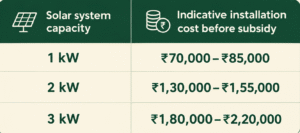
Source: Tamil Nadu Solar Rooftop Portal. These are indicative prices, not guaranteed quotations. Actual costs depend on the equipment, installation scope, roof structure, and other project-specific requirements.
A 1 kW system may be sufficient for a property with modest electricity consumption, while a larger home with multiple air conditioners may need a higher capacity. The right size should be determined from your electricity bills, daytime consumption, available roof space, and sanctioned electrical load.
For commercial and industrial installations, the price needs to be assessed separately. Larger systems can have different per-kilowatt costs because of economies of scale, structural work, electrical infrastructure, and project complexity.
2. How Much Does Solar Cost After Government Subsidy in Tamil Nadu?
Government assistance can significantly reduce the upfront cost for eligible residential customers.
Under the PM Surya Ghar: Muft Bijli Yojana, the central subsidy for eligible residential rooftop solar systems is ₹30,000 for 1 kW, ₹60,000 for 2 kW, and ₹78,000 for systems of 3 kW or more.
Tamil Nadu’s Solar Rooftop Portal also lists an additional state subsidy, bringing the published combined assistance to as much as ₹1,00,000 for eligible residential systems. The portal specifies that eligibility requirements and installation conditions apply.
Here is how the indicative cost can look using the portal’s published market-price figures.
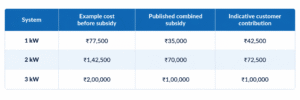
These examples use the midpoint of the portal’s indicative price range for each system size. They are illustrations, not fixed prices or guarantees of subsidy approval.
Important: Residential subsidies are not automatically available for commercial or industrial installations. Check your eligibility, the current scheme conditions, approved equipment requirements, and the relevant vendor process before signing a contract.
For the latest information, visit the Tamil Nadu Solar Rooftop Portal and the PM Surya Ghar portal.
3. What Factors Affect Solar Installation Costs?
Two solar companies can quote different prices for what appears to be the same system. That does not necessarily mean one is overcharging. The details of the proposed installation matter.
Solar panel quality and technology
The solar panels are one of the main components of your system. Different models have different efficiency ratings, dimensions, warranties, and performance characteristics.
Higher-efficiency panels can be particularly useful when roof space is limited. However, paying more for a panel is worthwhile only when its advantages make sense for your installation.
Ask the installer to identify the exact panel model rather than simply quoting a brand name.
Inverter and electrical equipment
Solar panels generate direct-current electricity, which the inverter converts into usable alternating-current electricity for your property.
The inverter must match the system design and electrical requirements. The quotation should also identify the protection devices, cables, earthing arrangements, and monitoring equipment included in the installation.
Roof structure and mounting
A straightforward rooftop installation can cost less than one requiring additional structural work.
In Chennai, installers should account for roof condition, shading, wind exposure, waterproofing, and safe maintenance access. Apartment rooftops and older buildings may need additional checks before installation.
A cheaper quotation that overlooks these requirements can lead to avoidable expenses later.
On-grid, off-grid, or hybrid system
The type of solar system also affects the price.
- On-grid solar: Usually a practical option for grid-connected properties seeking to reduce electricity purchases.
- Off-grid solar: Requires batteries and is designed to operate without relying on the utility grid.
- Hybrid solar: Combines grid-connected solar with battery storage and can support selected loads during outages, depending on the design.
Battery storage can add considerably to the upfront cost. If your main objective is to reduce daytime electricity bills, an on-grid system may be more economical than purchasing a battery that you do not regularly need.
Installation, approvals, and after-sales service
Always confirm whether the quotation includes the mounting structure, installation labour, electrical protection, earthing, commissioning, utility coordination, applicable metering arrangements, and monitoring.
Also check whether transport, roof reinforcement, additional wiring, or other work is excluded.
A detailed quotation is more useful than a low headline price that leaves important costs undisclosed.
4. How Much Does Solar Installation Cost for a Commercial Building?
Commercial solar pricing depends on the building’s electricity consumption, available roof area, electrical infrastructure, and system capacity.
For example, a small office in Velachery may have a very different requirement from a hotel on OMR or a manufacturing facility in Ambattur.
A commercial feasibility assessment should consider:
- Monthly electricity consumption and billing history.
- Daytime demand and the proportion of solar electricity that can be used directly.
- Available roof space and structural suitability.
- Electrical connection capacity and applicable utility requirements.
- Expected solar generation and the treatment of surplus electricity.
- Maintenance costs, financing, and expected payback period.
A business should not select a system purely because it has the lowest price per kilowatt. The more useful question is how much of the generated electricity will offset the property’s actual energy costs.
For industrial customers, it can also be worth assessing battery storage, peak-demand management, and power-quality requirements alongside solar generation.
5. How Much Can You Save with Rooftop Solar?
Solar savings depend on how much electricity the system generates and how much of that electricity your property uses effectively.
Tamil Nadu’s rooftop solar guidance gives an indicative generation range of around 4-5 units per day per kW of installed capacity, although actual production varies with site conditions, weather, shading, and equipment performance.
For a simple illustration, a 3 kW system generating an average of 4–5 units per kW per day would produce approximately 12–15 units daily under those assumptions.
That is not the same as saving the retail price of 12–15 units every day. Some electricity may be exported, and its financial treatment depends on the applicable billing arrangement. Your remaining bill may also include fixed charges and other applicable charges.
Before accepting a savings estimate, ask the installer to explain:
- Expected monthly electricity generation.
- Expected on-site solar consumption.
- How exported electricity will be credited.
- The estimated annual savings and assumptions behind them.
- The expected payback period after the eligible subsidy.
- Ongoing maintenance and likely equipment-replacement costs.
A realistic estimate based on your actual electricity bills is more valuable than a promise of guaranteed savings.
6. How to Choose the Right Solar Installation Company in Chennai
Finding a solar installation company is easy. Finding one that understands your requirements and provides dependable support is the more important task.
Before making a decision, compare at least two or three written quotations.
Check the technical proposal. It should specify system capacity, panel and inverter models, estimated generation, mounting arrangements, and electrical protection.
Verify subsidy eligibility. For eligible residential installations, confirm the required registration process, vendor eligibility, equipment conditions, and documentation.
Understand the warranty. Ask about panel product and performance warranties, inverter coverage, battery warranties if applicable, and installation workmanship guarantees.
Look for local service support. Your installer should explain who will respond if the system develops a fault or produces less electricity than expected.
Compare the complete price. Check whether the quotation includes installation, commissioning, approvals, metering coordination, and applicable taxes.
Ask for a site assessment. A reliable recommendation should account for your roof and electricity usage instead of offering the same capacity to every customer.
The best installer is not necessarily the cheapest. It is the one that provides a suitable system, a transparent quotation, realistic performance estimates, and clear responsibility for after-sales service.
7. Why Consider Kinetiq Energy for Solar Solutions?
If you are exploring solar power for a home, office, commercial property, or industrial facility in Chennai, Kinetiq Energy is one option to consider.
Kinetiq Energy’s offering extends beyond solar installation to include energy audits, battery energy storage, power-quality solutions, and energy-management services.
That broader perspective can be useful for businesses that want to understand their energy consumption before investing in equipment.
For example, a commercial property may benefit from understanding its daytime electricity demand before deciding how much rooftop solar to install. A facility with critical equipment may also need to assess whether battery storage or power-quality improvements are justified.
Rather than assuming every customer needs the same solution, the goal should be to match the system to the property’s energy requirements and financial objectives.
When contacting Kinetiq Energy, consider asking for:
- A review of your recent electricity bills.
- A rooftop and electrical feasibility assessment.
- A proposed system capacity and equipment specification.
- An estimate of generation, savings, and payback period.
- A clear breakdown of installation costs and exclusions.
- Details of warranty coverage and after-sales support.
The final quotation should make it easy to understand what you are paying for and why the recommended system suits your property.
8. Is Installing Solar in Chennai Worth the Investment?
For many homeowners and businesses, rooftop solar is worth evaluating because it can reduce reliance on grid electricity and provide long-term energy-cost benefits.
However, the financial result depends on the upfront investment, actual generation, electricity consumption, applicable tariffs, and maintenance requirements.
A property that uses a substantial amount of electricity during daylight hours may be well suited to on-grid solar. A property that needs backup during outages may need to consider a hybrid system. A factory with more complex electricity requirements may benefit from a broader energy assessment before selecting a solution.
The right approach is to understand your electricity consumption first, compare the available options, and then choose a system that fits your budget and operating needs.