
Overview of a Hybrid
Solar Systems
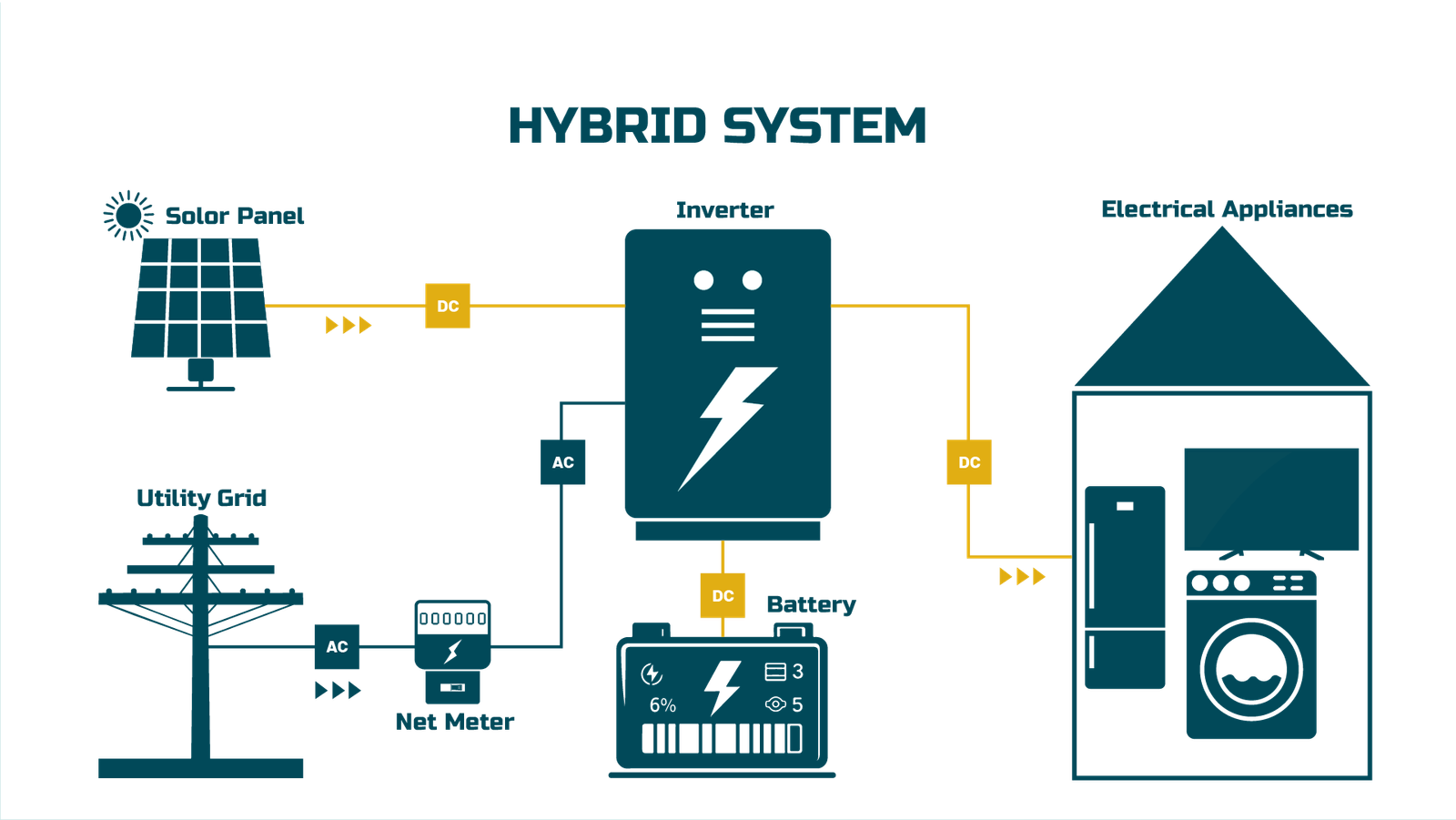
Working of an Hybrid
Solar System for Homes
1. Solar Panels
Absorb sunlight and convert it into DC electricity.
2. Combiner Box
Collects DC current from the panels.
3. Charge Controller
Manages the flow of DC electricity, charging the batteries and supplying power to the inverter.
4. Batteries:
Store excess electricity for use during non-sunlight hours or grid outages.
5. Hybrid Inverter:
Converts DC power to AC power for household appliances and manages the distribution of electricity between the grid, batteries, and home.
6. Grid Connection:
The system can draw power from the grid when needed and export excess solar power back to the grid, ensuring efficient energy use.
Hybrid Solar Components and Their Functions
Overview of a Hybrid Solar System
A hybrid solar system combines the best features of both on-grid and off-grid systems. It operates connected to the grid while also having battery storage to ensure continuous power supply. This system is designed to maximize energy independence and efficiency by utilizing both solar power and grid electricity.
1. Solar Panels
Solar panels, composed of solar cells, capture sunlight and convert it into direct current (DC) electricity. The panels can be monocrystalline (single silicon crystal) or polycrystalline (multiple silicon crystals). Both types have different efficiencies but perform the same basic function.
2. Hybrid Inverter
The hybrid inverter is the heart of the hybrid solar system. It converts the DC power generated by the solar panels into alternating current (AC) power, which is used by household appliances. Additionally, it manages the distribution of electricity between the grid, the batteries, and the home.
3. Batteries
Batteries store excess electricity generated during the day for use during the night or during grid outages. They ensure a continuous power supply, providing energy independence and reliability.
4. Charge Controller
The charge controller regulates the flow of electricity from the solar panels to the batteries and the inverter. It ensures the batteries are charged efficiently and prevents overcharging, thereby extending battery life.
5. Mounting Structures
Mounting structures are essential for positioning the solar panels at the optimal angle to maximize sunlight exposure. They must be robust and durable to withstand various weather conditions.
6. Solar Accessories
Various accessories are necessary for a safe and efficient hybrid solar system, including:
- DC cables and combiner box
- AC cables and combiner box
- MC4 connectors
- Earthing strips and conduit trays
- Lightning arrester

Hybrid Solar Systems with Different Capacities
| Capacity | Units Generated / Day | Units Generated / Year |
|---|---|---|
| 1 kW | 4 units | 1440 units |
| 2 kW | 8 units | 2880 units |
| 3 kW | 12 units | 4320 units |
| 4 kW | 16 units | 5760 units |
| 5 kW | 20 units | 7200 units |
| 10 kW | 40 units | 14400 units |
Cost of a Hybrid Solar Power System
The cost of a hybrid solar system varies based on the capacity and the battery backup required. On average, it ranges between ₹100-120 per watt peak, including batteries. The final cost depends on the size and capacity of the batteries needed to meet your energy requirements.
Return on Investment (ROI) of a Hybrid System
A hybrid solar system typically breaks even in about 5-6 years. The investment pays off by providing reliable power, reducing electricity bills, and offering energy independence.
Return on Investment (ROI) of a Hybrid System
- Energy Independence: Provides continuous power supply by combining solar power, grid electricity, and battery storage.
- Cost Savings: Reduces electricity bills by using solar power and exporting excess energy to the grid.
- Environmental Impact: Generates clean, green energy, reducing reliance on fossil fuels.
- No Battery Requirement: Grid acts as a battery, eliminating replacement costs.
- Reliable Backup: Ensures uninterrupted power supply during grid outages with battery storage.
Conclusion
A hybrid solar system is an excellent solution for maximizing energy efficiency and independence. It offers the benefits of both on-grid and off-grid systems, providing a reliable and cost-effective power solution for homes.
FAQs
What is a hybrid solar system?
How does a hybrid solar system work?
What are the benefits of a hybrid solar system?
How does Klymate customize solar solutions for RWAs and GHS?
Recent Projects

Submit a
Solar Project Enquiry
Our solar experts will guide you in your solar journey
Request A Quote
Recent Blogs
Solar EPC Explained: What Really Happens Between Signing the Contract and Switching On Your System
Solar Sounds Simple. The Process Isn't — And That's a Good Thing. Most people think going solar means picking panels and waiting for installation. In reality, a proper Solar EPC...

Graphene Batteries: Redefining the Next Phase of Energy Storage
Energy storage is the backbone of the clean energy transition. As renewable energy adoption grows and electric vehicles become mainstream, the demand for faster, safer, and...
Why Predictable Costs Beat Cheap Systems — Every Single Time
In business—and in life—price always matters. But experience teaches us something far more important: It’s not the price that hurts. It’s the surprise. A cheap system may look...