PM Surya Ghar Subsidy in Chennai: What Homeowners Actually Get, and How Not to Lose It
Chances are you didn’t come looking for a government scheme. You came because your last EB bill made you wince, or a neighbour on your street just got panels put up and you’ve been wondering ever since if it’s worth it for your own roof too.
So here’s the short answer: yes, the ₹78,000 solar subsidy you’ve seen floating around online is real, and for most independent homes in Chennai, it applies to you. Doesn’t matter if you’re in OMR, Medavakkam, Tambaram, Velachery, Sholinganallur, Porur, or Pallikaranai — the eligibility rules and the process are identical across the city. What changes is how much you get, and that comes down to the size of the system you install. There are also a few steps in the process where applications quietly get stuck, so it’s worth knowing them before you start, not after. Here’s everything, laid out plainly.
What is PM Surya Ghar Muft Bijli Yojana, really?
Strip away the scheme name and it’s fairly simple: it’s the central government’s residential rooftop solar programme, and it pays you back a fixed amount after your system is up and running.
One thing that trips people up — it isn’t a discount at checkout. You pay the full installation cost first. Once TANGEDCO confirms your net metering and commissioning, the subsidy lands in your bank account through Direct Benefit Transfer (DBT). So there’s an upfront outlay before the money comes back to you, and it helps to plan for that gap.
Applications are open right now, and the government is pushing hard for rooftop solar adoption at a national scale. Worth knowing: the subsidy window is expected to run through 31 March 2027, or close earlier if the national installation target is hit first. That’s not a reason to panic, but it is a reason not to keep pushing this to “next year.”
How much can you actually get?
The subsidy scales with your system size, up to a fixed ceiling:
● Up to 2 kW: ₹30,000 per kW — so a 2 kW system gets you ₹60,000
● 2–3 kW: an extra ₹18,000 for that third kW
● 3 kW and above: the subsidy caps at ₹78,000 — that’s the maximum under the central scheme, no matter how much bigger your system is
For most independent houses around Chennai, a 2–3 kW system is enough to cover a typical family’s daytime load comfortably — and it also happens to be the sweet spot where the subsidy covers the largest share of your cost.
What does it actually cost, before and after?
Numbers help more than percentages, so here’s what this looks like in practice:
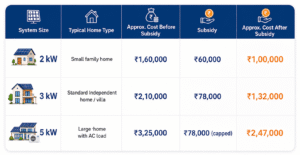
These are standard reference prices, not a quote for your specific roof. Your roof’s condition, shading, structure, and how far the cable run has to travel will all nudge the final number slightly — which is exactly why a site visit matters more than a phone estimate.
Net metering: it covers more than just your daytime bill
Here’s something most homeowners don’t realise until someone tells them: net metering under this scheme isn’t just offsetting the power your panels generate while the sun’s out.
If you have an LA1A or LA1D connection, net metering lets you offset your entire consumption — day and night — against what your system sends back to the grid. Your panels generate through the day, that generation gets credited against your total usage for the billing cycle, and whatever you draw at night pulls from that same credit. Size your system right, and your effective bill can drop to close to zero — not just during daylight hours, but across the whole cycle.
Does this actually apply to your situation?
This is where most of the confusion lives, and honestly, a five-minute call before you apply saves a lot of back-and-forth later.
If you own your home vs. live in an apartment: This scheme is built around individual households — your own rooftop, your own electricity connection. If you’re in an apartment or a gated community, the subsidy mechanics work differently. That’s not something a blog post can answer for you; it needs a conversation about your specific building.
Your sanctioned load isn’t a hard ceiling for subsidy projects: Normally, if you want a system bigger than your current sanctioned load, you’d have to apply separately for a load enhancement. But under PM Surya Ghar, that rule bends a little — if you apply for a system above your sanctioned load (say, a 5 kW system against a 3 kW connection), TANGEDCO automatically upgrades your sanctioned load to match, at no extra charge. Worth noting this upgrade path is specific to subsidy-linked applications, not standard installations.
Your panels need to be DCR-certified, not just “ALMM listed”: This one catches people out. ALMM (Approved List of Models and Manufacturers) has two parts — List-I covers approved solar modules, List-II covers approved solar cells. Plenty of panels are List-I approved but still use imported cells, which technically makes them “ALMM” in the loose sense, but not actually DCR-compliant. To qualify for the subsidy, your panels need both — the module (List-I) and the cells inside it (List-II) — approved. Install a non-DCR panel, and you lose the subsidy entirely, even if you’ve done everything else right. Get this confirmed with your installer in writing before work begins, not after the panels are already on your roof.
The application process, without the jargon
Here’s what’s actually involved, start to finish. KinetiQ handles every one of these steps on your behalf — this is really what you’re paying for when you hire an installer: the paperwork disappearing, not just the panels going up.
1. Register on the national portal (pmsuryaghar.gov.in) using your electricity consumer number
2. Get technical feasibility approval from TANGEDCO
3. Install the system with DCR-compliant equipment — module and cells both ALMM-approved
4. TANGEDCO completes net metering and inspection
5. Submit your bank details and commissioning report on the portal — the subsidy typically lands within 30–45 days
Two things worth checking before you commit
Before you sign off with any installer, these two things are worth five minutes of scrutiny:
● Whether your installer is actually on the current MNRE/TEDA empanelment list for subsidy processing in Tamil Nadu — this quietly determines how smoothly your claim moves through the system.
● Your building’s real sanctioned load and rooftop shading, since what looks good in a subsidy calculation on paper doesn’t always match what your roof can genuinely support.
Both take about fifteen minutes to check properly. And that fifteen minutes is often the difference between a subsidy that lands in 30 days, and one that sits in back-and-forth for months.
Frequently Asked Questions
How much subsidy can I get for rooftop solar in Chennai?
Eligible homeowners can receive up to ₹78,000 under the PM Surya Ghar scheme, depending on system size.
Can apartment owners apply for the PM Surya Ghar subsidy?
The scheme is designed primarily for individual homes with their own rooftops and electricity connections. Apartment and gated community projects need a separate, site-specific assessment.
Does net metering reduce my nighttime electricity bill?
Yes. For LA1A and LA1D connections, exported solar energy can offset both daytime and nighttime consumption.
How long does it take to receive the subsidy?
Generally within 30–45 days after commissioning and TANGEDCO approval.
Can I install non-DCR solar panels?
No. Only DCR-compliant panels — both module and cells ALMM-approved — qualify for the subsidy.