
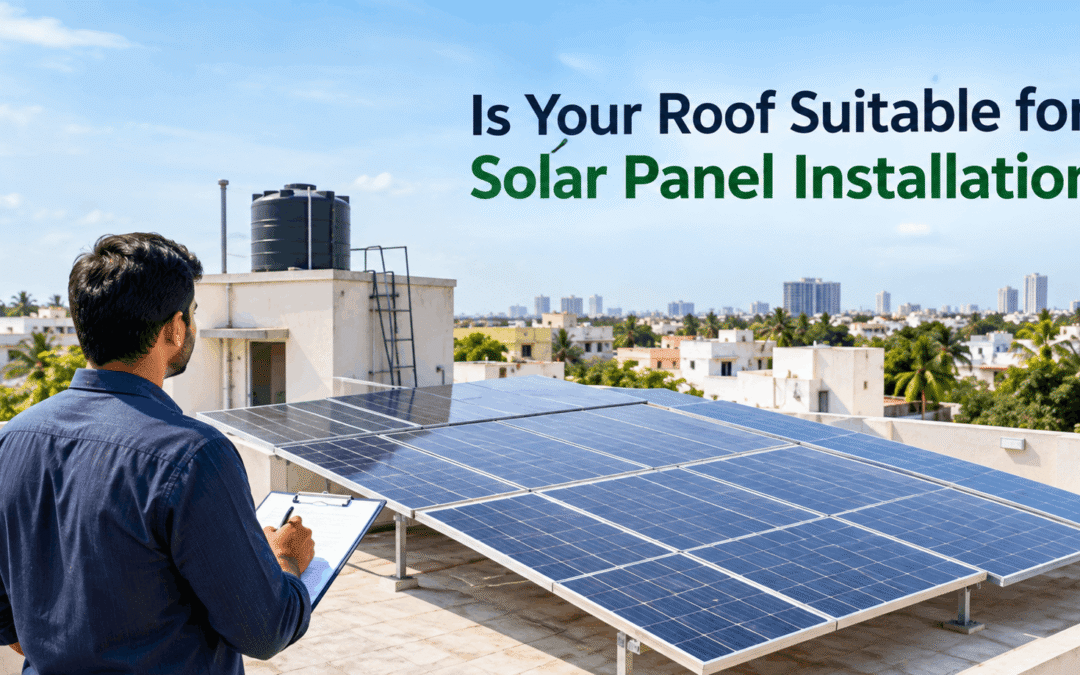
Thinking about installing solar panels on your home in Chennai? One of the first questions you should ask is not “How many solar panels do I need?” but rather:
“Is my roof actually suitable for solar?”
In most Chennai homes, the answer can be yes. But a good solar installation depends on more than simply having an empty terrace.
The roof needs enough usable space, reasonable sunlight exposure, suitable structural conditions, and a practical layout for installing and maintaining the panels. Things such as water tanks, staircases, neighbouring buildings, trees, parapet walls and existing electrical equipment can all affect the final design.
This guide explains the main things Chennai homeowners should check before installing a rooftop solar system.
What Makes a Roof Suitable for Solar Panels?
A solar-friendly roof generally has four important characteristics:
- Adequate usable space
- Good sunlight exposure
- Suitable structural condition
- Safe and practical access for installation and maintenance
The exact requirements depend on the size of the solar system you want to install.
For example, a home considering a 3 kW system will have different space requirements from a home planning a 5 kW or 10 kW installation.
A professional site survey is therefore more useful than simply measuring the total terrace area.
1. Does Your Roof Get Enough Sunlight?
Sunlight is the most important factor for rooftop solar.
Solar panels produce electricity when sunlight reaches their surface. If a large portion of the array is regularly shaded, electricity generation can be reduced.
For Chennai homes, potential sources of shade include:
- Neighbouring buildings
- Tall trees
- Water tanks
- Staircase rooms
- Parapet walls
- Antennas and satellite dishes
- Overhead structures
- Future construction on nearby properties
It is important to look at the roof throughout the day rather than checking sunlight only at one particular time.
MNRE technical guidance for solar installations emphasises designing the array to avoid shading; one MNRE specification, for example, calls for no shadow on modules between 8 a.m. and 4 p.m. throughout the year.
That doesn’t mean every residential roof must follow that exact project specification, but it highlights an important principle: shade analysis matters when designing a solar system.
2. Is There Enough Usable Roof Space?
A large terrace does not necessarily mean you have a large area available for solar panels.
Consider a typical Chennai independent house.
The terrace might contain:
- An overhead water tank
- Staircase access
- Clothes-drying area
- Solar water heater
- Utility equipment
- Parapet walls
- Existing structures
All of these reduce the usable area.
The solar installer should therefore calculate usable roof space, rather than simply looking at the total terrace dimensions.
This is particularly important when deciding between systems such as 3 kW, 5 kW and larger installations.
3. Does the Roof Orientation Matter?
Yes, orientation and panel positioning affect solar generation.
The installer needs to determine the best orientation and tilt for the location while considering the actual roof layout.
A flat concrete terrace can provide considerable flexibility because mounting structures can be used to position the panels appropriately.
For a sloped roof, the existing roof direction and pitch become more important.
The goal is not simply to place panels wherever there is empty space. The system should be designed around solar exposure, shading, tilt, structural conditions and maintenance access.
4. Is Your Chennai Roof Structurally Strong Enough?
This is one of the checks that should never be skipped.
Solar panels themselves are not extremely heavy individually, but the complete installation also includes mounting structures, fasteners, cables and other equipment.
An experienced solar company should inspect the roof before installation, particularly when the building is older or the terrace has visible signs of deterioration.
Look for issues such as:
- Major cracks
- Water seepage
- Damaged concrete
- Weak or deteriorated roofing
- Unusual settlement
- Previous structural modifications
If there are serious structural concerns, they should be addressed before proceeding with the solar installation.
Solar should be installed on a roof that is in suitable condition – not used as a reason to ignore existing structural problems.
5. What About Chennai’s Heat and Weather?
Chennai receives strong sunlight for much of the year, which is useful for solar generation.
But the rooftop environment also has to deal with high temperatures, seasonal rainfall and coastal conditions.
This makes the quality of the mounting system, electrical connections, cable management and installation workmanship important.
A good rooftop installation should have:
- Properly secured mounting structures
- Good-quality electrical connections
- Appropriate cable routing
- Proper earthing and protection
- Adequate spacing for maintenance
- Water-resistant installation practices where required
The objective is to create a system that can operate reliably for many years rather than simply completing the installation quickly.
6. Can Water Tanks and Staircases Stay on the Roof?
Absolutely—but they need to be considered during the solar design.
You should not expect the entire terrace to be covered with panels.
For example, if your terrace has a water tank in the centre, the installer can design the panel arrangement around it.
The same applies to:
- Staircase rooms
- Solar water heaters
- Ventilation areas
- Existing equipment
- Maintenance pathways
A well-planned layout should balance maximum solar generation with practical roof usage.
You still need access to important equipment after the solar system is installed.
7. What About Shadows from Nearby Buildings?
This is a common issue in densely developed areas of Chennai.
Your roof may receive plenty of sunlight in the morning but become shaded later in the day because of a neighbouring building.
This is why a proper site assessment is valuable.
The installer should identify significant shading sources and design the panel layout accordingly.
In some situations, moving a section of panels by a small distance can make a meaningful difference to the available sunlight.
8. Does an Old House Automatically Become Unsuitable?
No.
An older house is not automatically unsuitable for rooftop solar.
The important question is the current condition of the roof and building structure.
A 20-year-old building with a well-maintained RCC terrace may be perfectly suitable, while a newer building with structural or waterproofing problems may require attention before installation.
This is why the decision should be based on a site inspection rather than the age of the property alone.
9. What If Your Roof Is Small?
A small roof does not necessarily mean you cannot install solar.
Instead, your available roof area needs to be matched with your electricity consumption and desired system capacity.
For example, you may initially consider a 5 kW system because of your electricity usage, but the usable roof area might not comfortably accommodate that configuration.
In that situation, an installer can evaluate:
- Available panel area
- Panel dimensions
- Shading
- Roof layout
- Electricity consumption
- Sanctioned load
- Electrical connection requirements
The final system size should be based on the combination of these factors rather than electricity consumption alone.
10. What About Your Electricity Connection?
Roof suitability is only one part of the solar installation process.
For grid-connected rooftop solar in Tamil Nadu, the electrical connection and applicable metering process also matter.
Tamil Nadu’s current solar portal provides services for domestic rooftop solar under PM Surya Ghar as well as non-subsidy applications, net-meter applications and related processes.
Tamil Nadu’s published solar framework also specifies different metering mechanisms depending on consumer category and applicable conditions. For domestic consumers, net metering has been provided within the relevant sanctioned-load framework.
So before finalising the system, your installer should check your electricity connection details along with the roof.
11. Can You Get a Solar Subsidy?
For eligible residential consumers, rooftop solar may qualify for Central Financial Assistance under the PM Surya Ghar: Muft Bijli Yojana, subject to the scheme’s current rules and requirements.
The official scheme provides CFA for residential rooftop systems, with the structure based on the applicable capacity and benchmark cost.
Tamil Nadu also provides a dedicated solar portal with information about PM Surya Ghar, eligibility, documents, empanelled vendors and application procedures.
Because subsidy rules, documentation and application procedures can change, homeowners should verify the current requirements before making a purchase.
A Simple Roof-Suitability Checklist for Chennai Homes
Before installing rooftop solar, ask these questions:
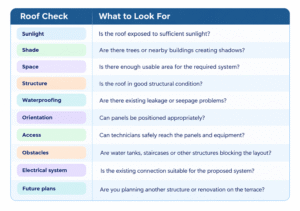
If several of these questions raise concerns, don’t immediately assume that solar is impossible. A professional site assessment can determine what can realistically be done.
What Should a Solar Site Survey Include?
A proper rooftop assessment should look beyond the roof dimensions.
Ideally, the installer should evaluate:
1. Roof measurements
Determine the actual usable area.
2. Shade analysis
Identify current and potential shading.
3. Structural condition
Check whether the roof and mounting arrangement are suitable.
4. Panel layout
Determine how many panels can realistically be installed.
5. Electrical assessment
Review the existing connection and system requirements.
6. Inverter location
Identify a suitable location with appropriate protection and accessibility.
7. Cable routing
Plan a safe and practical route between the panels, inverter and electrical system.
8. Maintenance access
Leave sufficient access for cleaning, inspection and future maintenance.
This process helps prevent a common mistake: buying a solar system first and discovering installation limitations later.
Common Mistakes Chennai Homeowners Should Avoid
Choosing the system size based only on terrace size
More roof area does not automatically mean you need a bigger solar system.
Your electricity consumption and electrical connection also matter.
Ignoring shade
A roof may look sunny from ground level while individual sections experience significant shading.
Installing over a damaged roof
Solar panels are a long-term investment. Existing leakage or structural problems should be addressed first.
Covering every available part of the terrace
Your terrace still needs access for water tanks, cleaning, repairs and other household activities.
Choosing a company based only on the lowest quotation
Solar is a long-term installation. Compare the equipment, engineering, warranties, workmanship, documentation and after-sales support—not just the initial price.
How Kinetiq Energy Can Help
If you’re planning rooftop solar in Chennai, Kinetiq Energy can help you evaluate whether your roof is suitable before you commit to a system.
A proper solar assessment should consider your roof layout, available sunlight, shading, usable area, electricity consumption and installation requirements.
For homeowners exploring rooftop solar, you can learn more about solar solutions through kinetiqenergy.com and discuss the appropriate system based on your property’s actual conditions.
So, is your Chennai roof suitable for solar panel installation?
In many cases, yes—but the answer cannot be determined simply by looking at the terrace from the ground.
A suitable rooftop needs enough usable space, good sunlight exposure, appropriate structural conditions and a practical layout for panels and electrical equipment.
The good news is that even roofs with water tanks, staircases, parapet walls or limited space may still be suitable when the system is properly designed.
Instead of asking, “Can I fit solar panels on my roof?”, ask a better question:
“What solar system can my roof safely and efficiently support?”
That is where a professional site assessment makes the difference.
For Chennai homeowners considering solar, taking a few minutes to assess the roof properly today can help avoid costly installation and performance problems later.