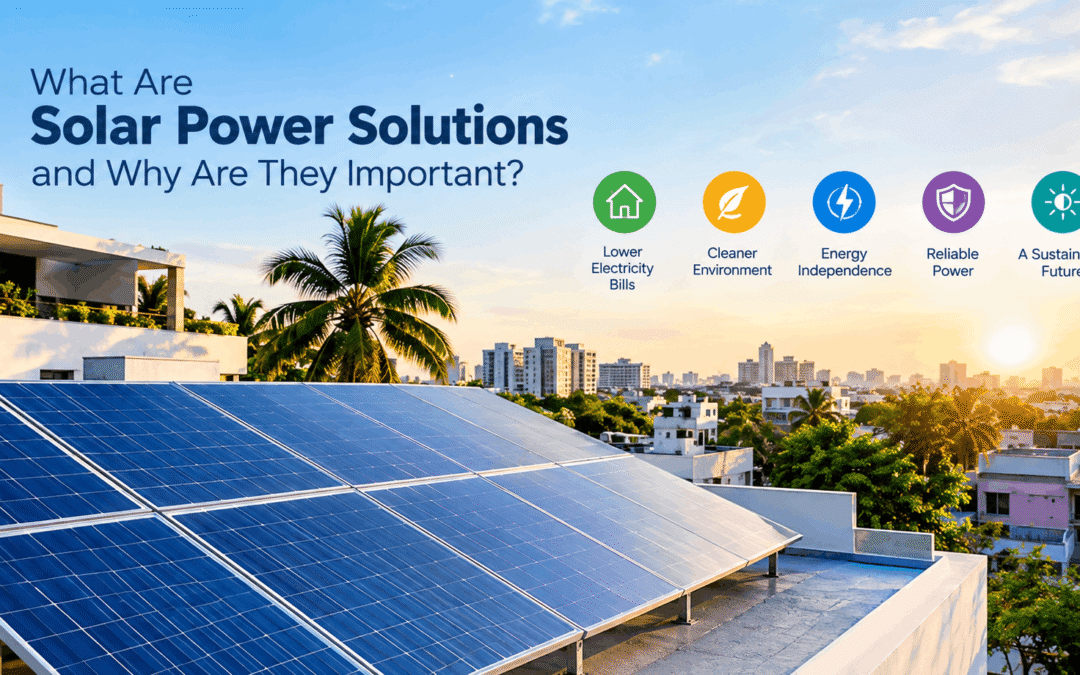
Electricity has become one of the biggest recurring expenses for homes, apartments, shops, offices, and industries in Chennai. With rising energy requirements, many people are now looking beyond conventional electricity sources and asking a simple question: Can solar power reduce my electricity costs while also giving me a more reliable and sustainable energy source?
This is where solar power solutions come in.
Solar power solutions are not limited to installing a few solar panels on a rooftop. They can include the complete process of understanding your electricity consumption, designing the right solar system, selecting suitable equipment, installing it safely, connecting it with the electricity grid, and maintaining the system for long-term performance.
For Chennai and the wider Tamil Nadu market, rooftop solar has become particularly relevant because homes and businesses can use available roof space to generate electricity from sunlight. Tamil Nadu’s current solar rooftop portal also provides mechanisms for residential consumers and other categories to apply for rooftop solar installations and net-metering-related services.
What Are Solar Power Solutions?
In simple terms, solar power solutions are systems and services designed to generate electricity using solar energy and use that electricity to meet a property’s energy requirements.
A solar solution can be designed for:
- Independent houses
- Villas
- Apartments and residential communities
- Schools and colleges
- Offices
- Commercial buildings
- Hospitals
- Shops and showrooms
- Warehouses
- Factories and manufacturing facilities
Depending on the property and its electricity consumption, a solar solution may involve a rooftop solar PV system, appropriate inverter technology, monitoring equipment, electrical protection, metering arrangements, and ongoing maintenance.
The important point is that there is no single solar system that is suitable for every customer.
A home consuming 500 units per month has different requirements from a factory consuming thousands of units. A good solar solution therefore starts with understanding the customer’s actual electricity usage rather than simply recommending a standard system size.
How Does a Solar Power System Work?
The basic working principle is straightforward.
Sunlight → Solar Panels → Inverter → Electrical Loads → Grid/Battery
Solar panels contain photovoltaic cells that convert sunlight into DC electricity. The inverter then converts this electricity into AC electricity that can be used by normal electrical appliances and equipment.
During the daytime, the solar system can supply electricity to loads such as:
- Air conditioners
- Refrigerators
- Water pumps
- Fans
- Lighting
- Computers
- Industrial machinery
- Other electrical equipment
If the solar system produces more electricity than the property is consuming at a particular time, the treatment of that excess electricity depends on the applicable metering arrangement and consumer category.
In Tamil Nadu, the applicable framework can differ between domestic and other consumer categories. TNPDCL’s published solar policy information describes net-metering for domestic consumers and net-feeding arrangements for several other categories, subject to the applicable rules and approvals.
That is why choosing the correct solar configuration and understanding the applicable electricity regulations are important parts of a solar project.
Why Are Solar Power Solutions Important for Chennai?
1. They Can Reduce Dependence on Grid Electricity
Most Chennai homes and businesses depend heavily on grid electricity for their daily operations.
For a house, this can include air conditioning, refrigerators, water heaters, washing machines and pumps.
For a commercial or industrial property, electricity consumption can be significantly higher.
A properly designed rooftop solar system can generate a portion of this electricity requirement during daylight hours, reducing dependence on grid-supplied power.
The actual savings depend on factors such as system capacity, electricity consumption, roof conditions, solar generation, tariff structure and the applicable metering mechanism.
2. Chennai Has Good Potential for Rooftop Solar
Chennai receives substantial sunlight for much of the year, making solar a practical option for many properties.
But sunlight alone does not determine how much electricity a system will generate.
A professional solar assessment should consider:
- Roof orientation
- Roof area
- Shading from nearby buildings
- Water tanks and other structures
- Panel layout
- Roof condition
- Electrical infrastructure
- Current electricity consumption
- Future electricity requirements
For example, two houses with the same roof size may require different solar designs because their electricity consumption and shading conditions can be completely different.
3. Solar Can Help Control Long-Term Electricity Expenses
One of the biggest reasons Chennai homeowners and businesses consider solar is the potential to reduce electricity costs over the long term.
Solar is generally a capital investment: you pay for the system upfront or through financing and then generate electricity from your own installation.
Once installed, the system can continue generating electricity for many years, although components such as inverters may have different lifespans and warranties.
The financial benefit should therefore be evaluated over the expected operating life of the system rather than based only on the first year’s electricity bill.
A proper solar proposal should ideally show:
- Estimated annual generation
- Expected electricity savings
- System cost
- Applicable subsidy, where eligible
- Payback estimate
- Warranty details
- Maintenance requirements
- Expected long-term performance
This makes the decision much clearer than simply comparing the price of solar panels.
4. Government Support Can Make Residential Solar More Accessible
For eligible residential consumers, government support can significantly reduce the initial cost of installing rooftop solar.
The PM Surya Ghar: Muft Bijli Yojana provides Central Financial Assistance for eligible residential rooftop solar installations. Under the published scheme structure, CFA is provided for the first 2 kW and an additional 1 kW, with no additional CFA beyond 3 kW under that structure.
Tamil Nadu’s current solar rooftop portal also states that eligible residential consumers can receive a combined Central and Tamil Nadu state subsidy of up to ₹1 lakh, subject to the scheme’s eligibility requirements and conditions.
The portal currently describes the residential assistance as:
- 1 kW — up to ₹35,000 total assistance
- 2 kW — up to ₹70,000
- 3 kW — up to ₹1,00,000
- Above 3 kW — maximum assistance remains ₹1,00,000 under the stated structure
These figures are scheme-specific and subject to eligibility, installation, metering, commissioning and other applicable requirements.
Therefore, homeowners should check the latest official scheme conditions before calculating their final investment.
5. Solar Is Useful for More Than Just Independent Houses
When people hear “rooftop solar,” they often imagine a few panels installed on an individual house.
But solar power solutions can be much broader.
For apartments
Apartment associations and residential communities can explore solar for common electricity requirements such as:
- Lifts
- Water pumps
- Corridor lighting
- Security systems
- Common-area electricity
- EV charging, where applicable
The PM Surya Ghar scheme also provides for eligible group housing societies and RWAs for common facilities, subject to the scheme’s conditions and capacity limits.
For commercial buildings
Solar can help businesses offset part of their daytime electricity consumption.
Examples include:
- Offices
- Hotels
- Retail outlets
- Restaurants
- Hospitals
- Educational institutions
- Warehouses
For factories
Industrial facilities often have substantial daytime electricity consumption, making solar an important option to evaluate.
However, industrial solar design requires more detailed analysis of:
- Connected load
- Sanctioned load
- Transformer capacity
- Consumption pattern
- Tariff structure
- Roof availability
- Electrical protection
- Applicable TNERC/TNPDCL rules
For larger installations, the right solution may involve rooftop solar, open-access arrangements, group captive structures, or other models depending on the project’s requirements.
6. Solar Power Solutions Are About More Than Solar Panels
A common mistake is to think that buying solar panels means you have purchased a complete solar solution.
In reality, several components work together.
Solar Panels
Solar modules capture sunlight and convert it into DC electricity.
Solar Inverter
The inverter converts the generated DC electricity into usable AC electricity.
Mounting Structure
The mounting structure securely supports the solar modules and positions them appropriately.
DC and AC Protection
Protection equipment helps protect the solar installation and electrical system from relevant electrical faults and abnormal conditions.
Monitoring System
Modern solar systems can provide information about electricity generation and system performance.
Metering and Grid Connection
Grid-connected systems require the appropriate approvals, documentation, metering and commissioning process.
Operations and Maintenance
Regular inspection, cleaning when required, monitoring and preventive maintenance can help maintain system performance.
This is why selecting an experienced solar EPC or installation company can be as important as selecting the equipment itself.
How to Choose the Right Solar Power Solution in Chennai
There is no universal “best” solar system for everyone. The right design depends on the property and its electricity requirements.
Before choosing a system, consider these factors.
1. Study Your Electricity Bills
Look at your recent electricity bills rather than using a rough guess.
Check:
- Monthly consumption
- Seasonal changes
- Maximum demand where applicable
- Tariff category
- Daytime versus nighttime consumption
This gives the solar installer a much better starting point.
2. Check Your Roof
The available roof area matters, but usable roof area matters more.
A roof may contain:
- Water tanks
- Staircase rooms
- AC outdoor units
- Antennas
- Nearby trees
- Other structures
These can affect the actual panel layout.
3. Check Shading
Even partial shading can affect solar generation.
A professional site survey should identify potential shading from:
- Trees
- Adjacent buildings
- Parapet walls
- Water tanks
- Other rooftop structures
4. Compare Equipment and Warranties
Do not compare solar proposals based only on price.
Look at:
- Panel specifications
- Inverter specifications
- Product warranties
- Performance warranties
- Mounting structure quality
- Protection equipment
- Monitoring
- Installation workmanship
- After-sales support
5. Understand the Complete Cost
Ask whether the quoted price includes:
- Design
- Solar modules
- Inverter
- Structure
- Cabling
- Protection systems
- Installation
- Testing
- Documentation
- Metering-related work
- Approvals
- Commissioning
- Maintenance
A low initial quotation is not necessarily the lowest overall cost if important components or services are excluded.
Solar Power Solutions and Net Metering in Tamil Nadu
For many residential solar customers, the relationship between the rooftop system and the electricity grid is an important part of the project.
Under a net-metering arrangement, electricity generated by the solar system is used by the consumer’s loads, while eligible excess generation can be exported to the grid according to the applicable rules. TNPDCL’s published documentation describes the calculation of imported and exported energy under net metering.
Tamil Nadu’s current rooftop solar portal also provides online services related to solar applications, net-metering documentation, plant details and commissioning.
Because regulations and procedures can change, customers should always verify the latest requirements before installing a system.
Is Solar Power Worth Considering for Your Chennai Home?
The answer depends on your individual situation.
Solar may be particularly worth evaluating when you have:
- A suitable rooftop
- Significant electricity consumption
- Good daytime energy usage
- Long-term plans to stay at the property
- Suitable grid connectivity
- Sufficient structural and electrical conditions
For example, a Chennai household that regularly uses air conditioning during the daytime may have a different solar opportunity from a household whose major electricity consumption happens late at night.
Similarly, a factory operating primarily during daylight hours may have a very different solar profile from a business that operates mainly after sunset.
The right solar capacity should therefore be based on actual electricity consumption rather than simply choosing the largest system that fits on the roof.
Why Professional Solar Installation Matters
Solar is a long-term investment. The quality of the installation can influence safety, reliability, generation and maintenance requirements.
A professional solar installation company should ideally help with the complete journey:
Electricity-bill analysis → Site survey → System design → Equipment selection → Installation → Electrical integration → Documentation → Metering/approval process → Commissioning → Monitoring → Maintenance
This end-to-end approach is particularly useful for Chennai properties where rooftop conditions, electricity requirements and applicable regulations can vary significantly.
For homeowners and businesses looking for a solar installation partner, Kinetiq Energy can be considered as part of the evaluation process for solar power solutions in Chennai. You can learn more about the company and its solar services at kinetiqenergy.com.
Solar Power Solutions: A Long-Term Energy Decision
Solar power is not simply about putting panels on a roof.
It is about making better use of an available energy resource and designing an electricity system around the actual needs of a property.
For Chennai homeowners, apartments, commercial buildings and industries, solar can provide an opportunity to generate electricity on-site, reduce dependence on conventional grid power and potentially lower long-term electricity expenses.
The key is to approach solar as a complete solution rather than a panel purchase.
Before investing, understand your electricity consumption, assess your roof, compare equipment and warranties, calculate the expected financial returns, and verify the latest Tamil Nadu and national scheme requirements.
With the right design and professional installation, solar power solutions can become a practical part of a property’s long-term energy strategy.
Frequently Asked Questions
What are solar power solutions?
Solar power solutions are complete systems and services that use solar energy to generate electricity. They can include solar panels, inverters, mounting structures, electrical protection, monitoring, installation, grid connection and maintenance.
Are solar power solutions suitable for Chennai homes?
Yes, rooftop solar can be evaluated for many Chennai homes, provided the property has suitable roof space, structural conditions, electricity connectivity and other required conditions.
Can apartments install solar?
Yes. Apartments and RWAs can evaluate solar for common facilities such as lifts, pumps and common-area electricity. Eligibility for government support depends on the applicable scheme conditions.
Is solar useful for factories?
Solar can be particularly relevant for facilities with significant daytime electricity consumption. Industrial projects, however, require a more detailed assessment of load, tariff, electrical infrastructure and applicable regulations.
Does solar eliminate the electricity bill completely?
Not necessarily. Solar generation depends on system size, sunlight, shading, consumption patterns and other factors. Grid charges, fixed charges and applicable billing mechanisms can also affect the final electricity bill.
How much subsidy is available in Tamil Nadu?
The current Tamil Nadu rooftop solar portal states that eligible residential consumers can receive combined Central and Tamil Nadu assistance of up to ₹1 lakh, subject to eligibility and scheme requirements.
Should I choose solar based only on the lowest quotation?
No. Compare system design, equipment quality, warranties, installation standards, approvals, monitoring, after-sales service and the expected generation—not just the initial price.