
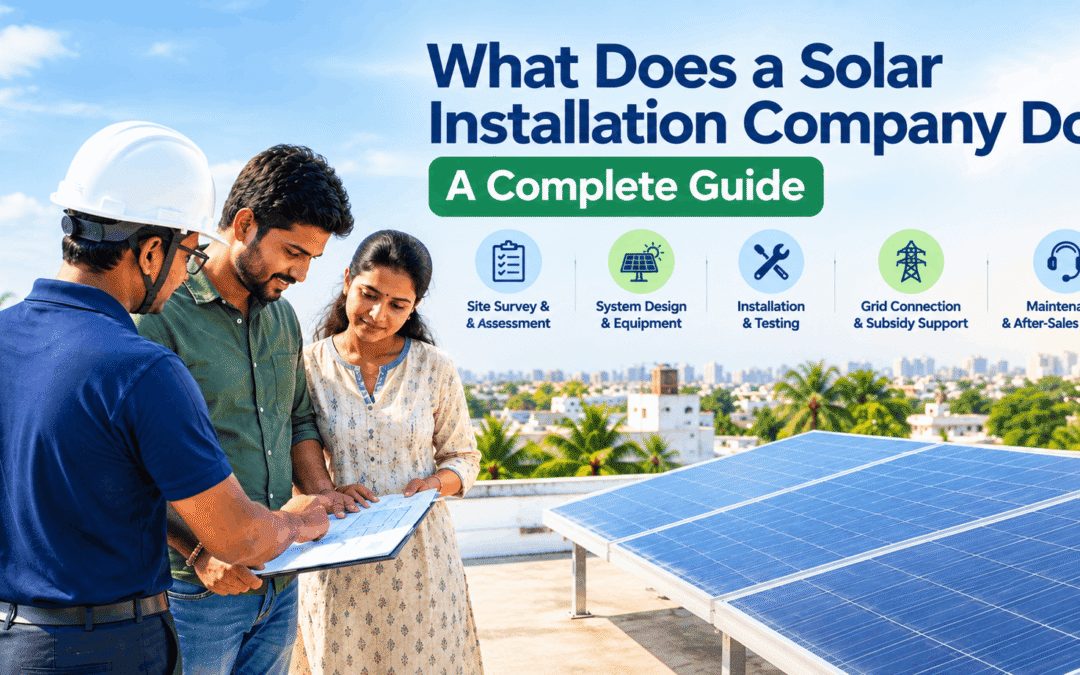
What Does a Solar Installation Company Do? A Complete Guide for Chennai Homeowners and Businesses
Solar energy has become a practical option for many homes, apartments, shops, offices and industries across Chennai. With electricity costs, rising energy requirements and increasing interest in renewable energy, more property owners are considering rooftop solar.
But one question often comes up:
What exactly does a solar installation company do?
A solar company does much more than simply place solar panels on your roof. A professional solar installation company studies your electricity consumption, checks your roof, designs the right system, selects the equipment, handles installation and electrical work, helps with the grid-connection process and provides support after commissioning.
For a Chennai homeowner or business owner, understanding this process can make it much easier to choose the right solar partner.
In this guide, let’s look at what a solar installation company actually does—from the first site visit to the day your rooftop solar system starts generating electricity.
What Is a Solar Installation Company?
A solar installation company is a company that designs, supplies, installs and commissions solar photovoltaic (PV) systems.
Depending on the company and project, its services may include:
- Solar site inspection
- Electricity-consumption analysis
- Solar system design
- Solar panel and inverter selection
- Structural design
- Electrical design
- Installation
- Earthing and protection systems
- Monitoring system setup
- Net-metering or grid-connection assistance
- Government subsidy assistance where applicable
- Testing and commissioning
- Warranty coordination
- Maintenance and after-sales support
In simple terms, a good solar company takes you from “I want solar” to a working solar power system on your property.
1. Understanding Your Electricity Consumption
The first step should not be choosing a panel.
It should be understanding how much electricity you actually use.
A professional solar installation company will normally look at your previous electricity bills and study:
- Monthly electricity consumption
- Sanctioned load
- Tariff category
- Daytime versus nighttime usage
- Seasonal changes in consumption
- Existing electrical infrastructure
- Available rooftop area
For example, a Chennai home consuming around 300–400 units per month may have very different solar requirements from a house consuming 800–1,000 units.
Similarly, a factory running machinery throughout the day will have a completely different solar requirement from a residential property.
This is why simply asking for a “5kW solar system price” may not give you the complete answer.
The right system depends on your electricity consumption, roof conditions and financial objective.
2. Conducting a Rooftop Site Survey
After understanding your electricity usage, the solar company should inspect the property.
For a Chennai rooftop, the site survey is particularly important because available roof space can vary significantly between independent houses, apartments, commercial buildings and factories.
The installer checks factors such as:
Roof area
The company determines how much usable space is available for installing solar modules.
Shading
Water tanks, nearby buildings, trees, parapet walls and other structures can create shadows.
Even partial shading can affect solar generation, so the installation team needs to understand the roof throughout the day.
Roof structure
The company should assess whether the roof can safely accommodate the proposed mounting structure.
Panel orientation and layout
The layout needs to provide suitable exposure to sunlight while allowing reasonable access for maintenance.
Electrical location
The distance between the rooftop, inverter and main electrical panel can affect cable routing and installation requirements.
A proper site survey helps prevent problems later.
3. Designing the Solar Power System
Once the site and electricity consumption have been studied, the solar company creates a system design.
This is one of the most important parts of the entire project.
The design can determine:
- Number of solar panels
- Solar system capacity
- Panel arrangement
- Inverter capacity
- String configuration
- Cable sizing
- Mounting structure
- Earthing arrangement
- Protection devices
- Monitoring system
- Electrical connection method
For example, a company may recommend a 3kW, 5kW, 10kW or larger system depending on the customer’s requirements.
The goal should not simply be to install the biggest possible system.
The goal is to design a system that makes sense for the property’s consumption, available roof area, electrical connection and budget.
4. Selecting Solar Panels and Other Equipment
A solar installation company is also responsible for selecting the major components of the system.
A typical rooftop solar system includes:
Solar panels
Solar panels convert sunlight into DC electricity.
Solar inverter
The inverter converts the electricity generated by the panels into usable AC electricity for the building and grid connection.
Mounting structure
The structure securely holds the solar panels above the roof.
DC and AC cables
These carry electricity between the solar modules, inverter and electrical system.
Protection equipment
Depending on the system design, appropriate protection and isolation equipment is installed to improve electrical safety.
Earthing and lightning protection
The installation should include suitable electrical safety arrangements according to the system design and applicable standards.
The quality of these components matters.
A solar system is expected to operate for many years, so choosing equipment purely on the basis of the lowest initial price can be a poor approach.
MNRE maintains standards and quality-control requirements for solar PV components and systems, including requirements concerning modules and inverters.
5. Handling the Solar Installation
This is the part most people associate with a solar company.
The installation team typically handles:
- Mounting structure installation
- Solar panel installation
- DC cable installation
- Inverter installation
- AC cable connections
- Earthing
- Protection devices
- Electrical integration
- Monitoring setup
- System testing
For a Chennai home, installation quality matters because the system will be exposed to strong sunlight, heat, rain and coastal environmental conditions depending on the location.
A professional installation should therefore focus not only on getting the panels onto the roof but also on safe cable routing, proper mounting, weather considerations and long-term accessibility.
6. Helping With Grid Connection and Net Metering
For a grid-connected rooftop solar system, the project doesn’t end after the panels are installed.
The system may need to be connected to the electricity distribution network through the applicable process.
In Tamil Nadu, the TNPDCL rooftop solar portal provides services for rooftop PV applications and net-metering-related processes.
Depending on the applicable category and scheme, the process can involve:
- Application submission
- Feasibility approval
- Solar installation
- Inspection
- Meter-related procedures
- Documentation
- Commissioning
- Grid connection
A good solar installation company should guide the customer through the applicable process rather than leaving the homeowner to figure everything out alone.
Tamil Nadu’s rooftop-solar framework includes mechanisms such as net metering, net feed-in and gross metering, subject to the applicable consumer category, capacity and regulations.
7. Helping Customers Understand Government Subsidies
Government incentives are another area where customers often need assistance.
For eligible residential consumers, the PM Surya Ghar: Muft Bijli Yojana provides central financial assistance for rooftop solar.
Tamil Nadu’s current portal also lists an additional state subsidy of ₹5,000 for 1kW, ₹10,000 for 2kW and ₹22,000 for 3kW and above, taking the combined assistance to as much as ₹1 lakh for eligible households, subject to the scheme’s conditions.
Importantly, subsidy eligibility is not simply about buying solar panels.
The system, vendor, documentation, commissioning and other scheme requirements have to satisfy the applicable rules. The Tamil Nadu portal states that eligible systems must meet specified requirements, including DCR-compliant and ALMM-listed module requirements for the scheme.
A reliable solar company should explain these requirements clearly before installation.
8. Explaining How Much Electricity the System Can Generate
Solar generation is not exactly the same every day.
A professional installer should therefore avoid promising an unrealistic fixed number of units every month.
Solar production depends on:
- System capacity
- Sunlight availability
- Roof orientation
- Shading
- Panel temperature
- Dust and dirt
- Inverter efficiency
- Cable losses
- Weather conditions
- System maintenance
Tamil Nadu’s official rooftop solar calculator itself notes that actual production varies based on factors such as roof orientation, tilt, shading, panel temperature, inverter efficiency and system losses.
This is particularly relevant in Chennai.
The city receives strong sunlight for much of the year, but cloudy weather, monsoon conditions, dust and rooftop heat can influence daily generation.
So instead of asking only:
“How many units will my solar system generate?”
it is better to ask:
“What annual generation can I reasonably expect from this specific roof and system design?”
9. Monitoring the Solar System
Modern solar systems can be monitored digitally.
Depending on the inverter and monitoring platform, customers may be able to see:
- Daily generation
- Monthly generation
- Current power output
- Historical production
- System alerts
- Inverter status
This helps homeowners identify unusual drops in generation.
For example, if a system normally generates well but suddenly produces significantly less electricity, the monitoring data can help identify that something needs attention.
10. Providing Maintenance and After-Sales Support
Installing solar is not the end of the relationship.
A good solar installation company should also explain how the system will be maintained.
Typical maintenance can include:
- Panel cleaning
- Visual inspection
- Cable inspection
- Inverter checks
- Monitoring system checks
- Electrical connection inspection
- Performance analysis
Solar panels generally require relatively low maintenance, but that does not mean they should simply be forgotten after installation.
Dust, bird droppings and other deposits can reduce the amount of sunlight reaching the panels.
Regular inspection and cleaning can help maintain system performance.
11. Handling Warranty and Service Issues
Solar equipment comes with warranties, but customers often find warranty terms confusing.
A professional solar company should clearly explain:
- Product warranty
- Performance warranty where applicable
- Inverter warranty
- Installation warranty
- What is covered
- What is not covered
- How service requests are handled
This becomes important several years after installation.
A company that disappears after receiving the installation payment may leave the customer struggling to deal with equipment manufacturers independently.
That is why after-sales service should be considered when selecting a solar installation company.
Solar Installation Company vs. Solar Panel Seller
There is an important difference between buying solar equipment and hiring a complete solar installation company.
A solar equipment seller may primarily supply:
- Panels
- Inverters
- Structures
- Other equipment
A full-service solar installation company may handle the entire project:
Energy assessment → Site survey → System design → Equipment selection → Installation → Electrical work → Grid connection assistance → Commissioning → Monitoring → Service
For a homeowner who doesn’t have technical knowledge of solar systems, the second approach can be much simpler.
What Should Chennai Homeowners Ask a Solar Company Before Installation?
Before signing an agreement, ask the company these questions:
1. What system capacity do I actually need?
Ask for the reasoning behind the proposed capacity.
2. What will the system generate annually?
Look for a realistic generation estimate rather than an exaggerated promise.
3. Which panels and inverter are you using?
Ask for the exact manufacturer and model.
4. What type of mounting structure will be installed?
Understand the material, design and corrosion protection.
5. Who will handle the grid-connection process?
Clarify what is included in the company’s scope.
6. Am I eligible for a government subsidy?
Ask the company to explain the current eligibility conditions rather than assuming every project qualifies.
7. What is included in the quoted price?
Check whether the price includes:
- Installation
- Structure
- Wiring
- Earthing
- Protection equipment
- Monitoring
- Documentation
- Meter-related work
- Taxes
- Maintenance
8. What happens if there is a problem after installation?
Understand the company’s service process.
9. What warranties do I receive?
Get warranty details in writing.
10. Will I receive a proper system handover?
You should ideally receive relevant documents, equipment information and warranty details after commissioning.
How Much Roof Space Do You Need?
The exact space requirement depends on the panel technology, panel wattage, layout and installation conditions.
A solar installer should therefore inspect the roof before giving a final recommendation.
For Chennai houses, rooftop planning can become challenging when the roof already contains:
- Water tanks
- Staircase rooms
- Solar water heaters
- Satellite dishes
- Clothes-drying areas
- Overhead structures
- Adjacent-building shadows
A professional layout should consider these practical issues instead of simply calculating the roof’s total square footage.
Is Solar Suitable for Every Chennai Home?
Not necessarily.
Solar can be a strong option for many properties, but the suitability of a particular roof depends on several factors.
For example:
Good conditions may include:
- Adequate usable roof space
- Good sunlight exposure
- Limited shading
- Suitable electrical infrastructure
- Sufficient electricity consumption
- Long-term ownership or use of the property
Potential challenges may include:
- Heavy shading
- Limited roof area
- Structural limitations
- Complicated electrical infrastructure
- Frequent changes to the property
- Very low electricity consumption
This is why a proper site assessment is more useful than a generic “solar is good for everyone” sales pitch.
How Kinetiq Energy Can Help
For homeowners, apartments, commercial properties and businesses in Chennai, choosing a solar partner is about more than finding someone who can install panels.
Kinetiq Energy focuses on helping customers understand their solar requirements and move through the installation process with a practical approach.
From understanding your electricity consumption to planning the rooftop system and completing installation, the objective should be to build a solar system that fits the property’s actual requirements.
A solar installation company is not simply a contractor who puts panels on your roof.
A professional solar company should be able to manage the complete journey:
Electricity analysis → Site survey → Solar design → Equipment selection → Installation → Electrical integration → Grid connection assistance → Commissioning → Monitoring → After-sales service
For Chennai homeowners, this complete approach is particularly important because every property is different.
The right solar system for a compact independent house may not be the right system for a large villa. An apartment has different considerations from a factory. A commercial building may have different electricity-consumption patterns from a residential property.
So, before choosing a solar company, don’t look only at the price per kW.
Look at the design, equipment, installation quality, documentation, grid-connection support, warranties and after-sales service.
A well-designed rooftop solar system is a long-term investment. Taking the time to choose the right installation partner can make the entire experience much easier—from the first site visit to years of solar generation.